



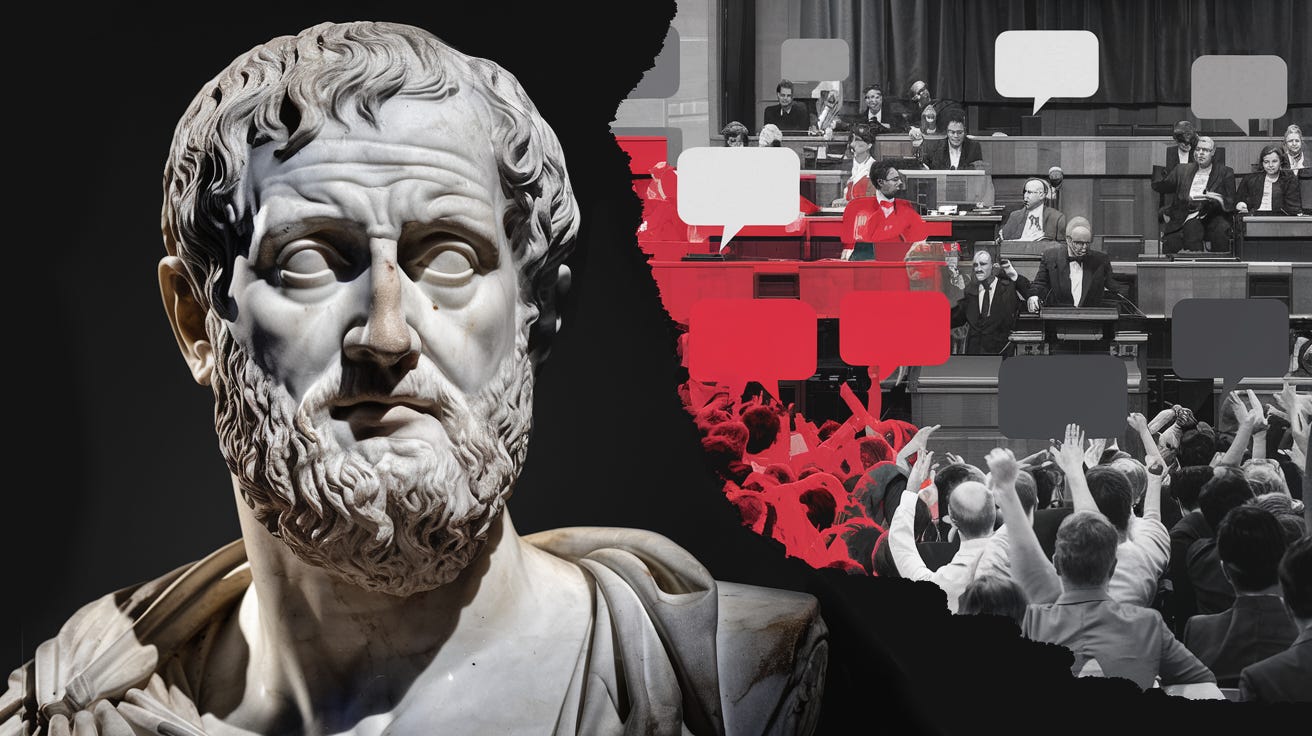
If you pick up Aristotle’s Rhetoric, you might expect a handbook for clever speaking. Instead, the opening chapters read like a defense of why rhetoric is not just a frivolous ornament, but a civic necessity. Aristotle’s core concern is simple: in courts, assemblies, and public disputes, the better case does not always win. People can judge poorly. They can be misled. They can fail to grasp the essential structure of an issue. For Aristotle, rhetoric is the disciplined art that helps prevent such failures.
Truth and justice are “stronger,” yet they can still lose
Aristotle begins with a claim that may sound optimistic: what is “true and just” is, by nature, stronger than its opposites. However, this does not mean that truth inevitably prevails. It means that truth and justice have an intrinsic advantage. They align more closely with reality and the norms of sound judgment than falsehood and injustice do.
But Aristotle immediately draws a sobering conclusion: when judgments are not made “as is fitting,” truth and justice can be defeated. Not because they are weaker, but because they are poorly presented or poorly understood. His argument is not “truth is weak, so we need rhetoric,” but rather, “truth is superior, and it is shameful to let it lose.” When a falsehood defeats a sound argument, the failure lies in human discernment and in the speaker’s inability to present what should have been persuasive.
Aristotle’s intention, therefore, is not to teach people how to dress up any claim in order to persuade anyone of almost anything. Rhetoric, at its core, exists to prevent the loss of truth and justice through avoidable failures in reasoning and presentation.
Why knowledge does not automatically persuade
Aristotle then offers a second, timeless insight that is especially relevant today. Even if you possess exact knowledge, it may still be difficult to persuade certain audiences by relying solely on conveying that knowledge. Scientific discourse, he argues, belongs in the realm of instruction. But in many real-world situations, instruction is not possible.
This is a sharp diagnosis of a common frustration: you can be empirically right and still fail to persuade. You may have evidence, yet your interlocutor remains unmoved. Aristotle identifies a mismatch between two modes of communication.
Instruction, as he defines it, aims at understanding. It works best when the audience is prepared, when time allows for careful explanation, when listeners adopt the role of students, and when one can proceed step by step.
Real-world situations are often different. Courts, assemblies, and public forums do not offer classroom conditions. People are busy, emotionally charged, and often unprepared to follow a technical argument. Aristotle is not claiming that teaching is inferior to rhetoric, only that each has its time and place.
Even the most knowledgeable speaker will encounter situations where informing an audience or interlocutor proves impossible, despite the relevance and urgency of the facts they bring.
Arguing from what is common
So what can you do instead? Aristotle argues that you must construct proofs and arguments from “what is common,” meaning shared starting points that your audience can recognize. In other words, persuasion begins from premises that are broadly accessible, not from the deepest technical basis you may possess.
This is not an invitation to abandon intellectual rigor. Rather, it is a necessary strategy for bridging gaps in background knowledge. If your audience lacks the conceptual tools to follow your best arguments, then your best arguments, as stated, will not even register as such. The art of rhetoric, then, supplies methods for identifying the kinds of considerations that can move an uninformed audience, without turning the encounter into an impossible lesson.
Aristotle’s work on logic and dialectic in the Topics also addresses how to engage “the many,” meaning ordinary interlocutors who do not share a specialized knowledge base. Both dialectic and rhetoric, he argues, deal with matters that fall within people’s general awareness, and they work from what people can plausibly understand and apply to shared concerns.
Mastering rhetoric as a civic responsibility
Today, it may be tempting to translate rhetoric into modern terms as persuasive “packaging” of arguments and language. But “packaging” suggests spin, cosmetics, or manipulation. Even though these may be the most visible ways rhetoric is misapplied in our time, Aristotle’s justification for its existence as an art form is more principled and less cynical.
If public decisions matter, and if the people who make them can be misled, then it is irresponsible to allow truth and justice to go undefended. In some cases, it is equally irresponsible to offer an inadequate and ineffective defense. Rhetoric is, whether we like it or not, part of practical reason in every aspect of our lives. Without it, you can forget about making your crucial arguments visible in a form that might persuade real audiences.
Aristotle also recognizes that persuasion has multiple dimensions, including the character of the speaker, the disposition of the audience, and the form in which an argument is presented. The reality he exposes here is timeless, but it is no less disappointing for those who prefer to stick to facts, logic, and reason. People, in the aggregate, are simply not pure intellects. In fact, you will rarely encounter an interlocutor willing to set aside personal interests and preoccupations in pursuit of what is genuinely true and good.
Aristotle’s Rhetoric offers a wise piece of advice: refusing to use rhetorical techniques does not make you more rational. It simply ensures that your arguments will remain ineffective and ignored.
The enduring lesson
Aristotle’s opening argument can be distilled into a modern rule of thumb. Having knowledge is not enough. If you want to persuade those who do not share your knowledge, background, or training, you must speak from common ground. You must translate your arguments into rhetorical form without betraying the truth. You must build bridges from what your audience already understands to what you need them to see.
That is why Aristotle did not see rhetoric the way it is often viewed today, as mere window dressing or linguistic flair designed to make statements more appealing, like a kind of public relations gloss. He understood that all the training in logic and science is of little use if one cannot communicate ideas effectively with those who need to be persuaded.
Persuasion matters not because truth is inherently fragile, but because human discernment is. When the stakes are high, the ability to speak convincingly is essential to ensuring that the better case prevails.
Explore more Popular Philosophy:
Start Philosophy | Definitive Guides | Topics | Today in Philosophy | Podcast
Popular Philosophy publishes definitive guides and essays centered around moral realism, objective truth, Stoicism, ancient philosophy, medieval philosophy, and deeper explorations of the true, the good and the beautiful. Expect carefully researched articles that dissect current event through timeless ideas, for readers who want clear reasoning, primary sources, intellectual honesty and serious philosophy, free from ideological trends and academic fashion.
Subscribe now to support our growing, independent philosophical knowledge base on the timeless questions that shape human life and civilization.