


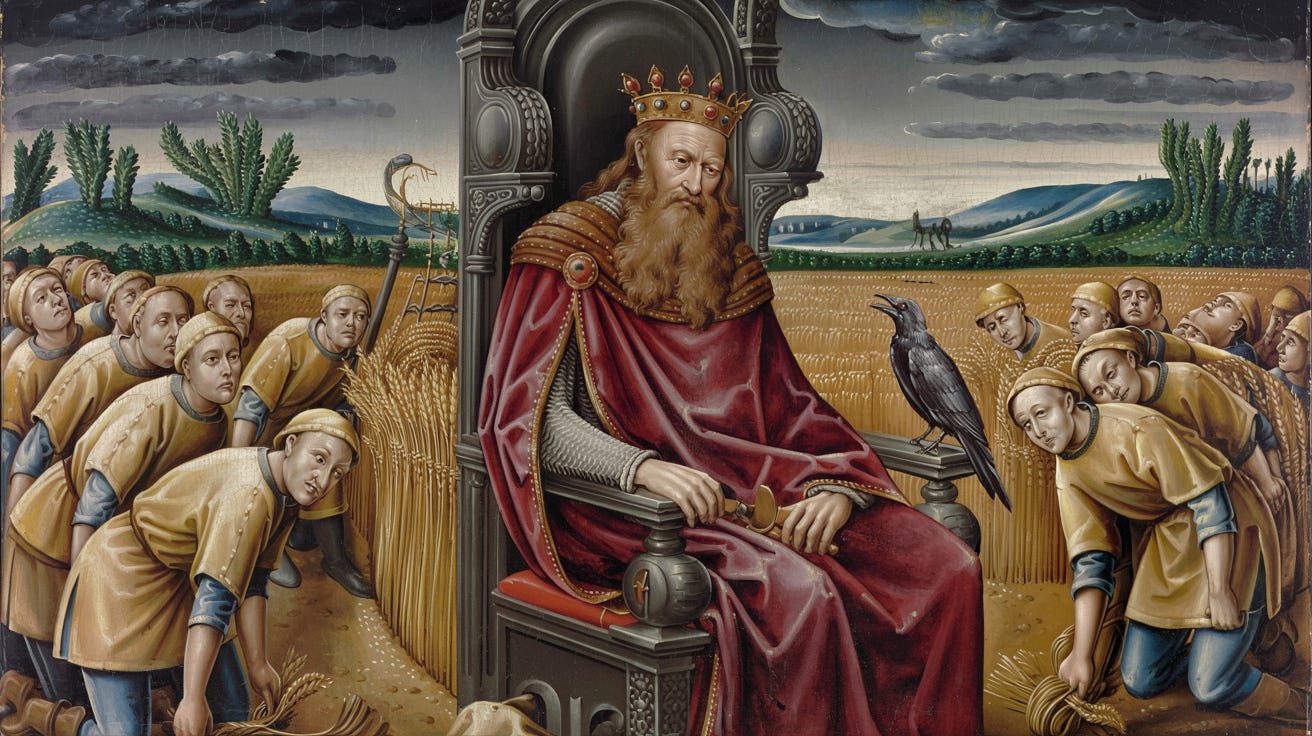
There is a fundamental conflict at the heart of human civilization that goes beyond the left versus right paradigm. It is not conservative versus liberal. It is a much older and more profound struggle. It is the conflict between the creators and the takers. The eternal war between the productive and the parasitic.
Murray Rothbard on the true nature of power
The Austrian economist and historian Murray N. Rothbard shed light on this conflict in his seminal 1974 essay, Anatomy of the State, articulating the distinction with piercing clarity:
Social power is the power over nature, the living standards achieved by men in mutual exchange. State power, as we have seen, is the coercive and parasitic seizure of this production—a draining of the fruits of society for the benefit of nonproductive (actually antiproductive) rulers. While social power is over nature, State power is power over man. Through history, man’s productive and creative forces have, time and again, carved out new ways of transforming nature for man’s benefit. These have been the times when social power has spurted ahead of State power, and when the degree of State encroachment over society has considerably lessened. But always, after a greater or smaller time lag, the State has moved into these new areas, to cripple and confiscate social power once more.
What is social power? The engine of creation
Let us dissect what Rothbard is getting at here. He presents two diametrically opposed forces. Social Power is human cooperation. It is the farmer planting a seed, the engineer designing a bridge, the programmer writing code, and the entrepreneur organizing resources to provide valuable goods and services. It is the voluntary and peaceful exchange between people that creates wealth and improves life. It is fundamentally creative and its domain is the mastery of nature for human benefit. Every technological advance, every medical breakthrough, and every improvement in living standards is a victory for social power.
What is state power? The machinery of seizure
State Power is the opposite. It creates nothing, truly. Its power is not over nature but over other people. The state produces no wheat, builds no software, and cures no diseases. Instead, it exists by seizing the products of social power through various means of confiscation and monopolization. Rothbard correctly identifies it as a parasitic institution, draining the lifeblood of the productive to feed a class of rulers and their enforcers. The state is a brake on progress, a dead weight on civilization. History is a cycle of social power spurting forward with innovation, only for the state to catch up, wrap its tentacles around the new creation, and begin to drain it dry.
Beyond the state: identifying the broader criminal class
This analysis is fundamentally correct, but does it go far enough? Rothbard assigns the state to its own special category, distinct from the rest of society. And indeed, most people would agree that its methods and machinery are unique. The average citizen cannot legally demand a portion of his neighbor’s income under threat of imprisonment. The average company cannot declare a monopoly on a service and outlaw all competition. And who could even dream of making the rest of society pay for goods and services nobody asked for? Yet, is the state truly alone in employing this parasitic modus operandi?
It is not. The state is merely the most successful and sophisticated gang in that aspect. It is what the economist Mancur Olson termed the “stationary bandit.” A roving bandit might loot a village and move on, but a stationary bandit settles down, claims ownership, and figures out he can extract more wealth over the long term by “protecting” his victims and taking a regular tribute. The state has perfected this model of organized crime and risen to become the apex predator. But there are smaller fish swimming in the same pond: street robbers, Ponzi schemers, counterfeiters, and drug cartels all operate on a similar principle of anti-social, non-productive resource extraction.
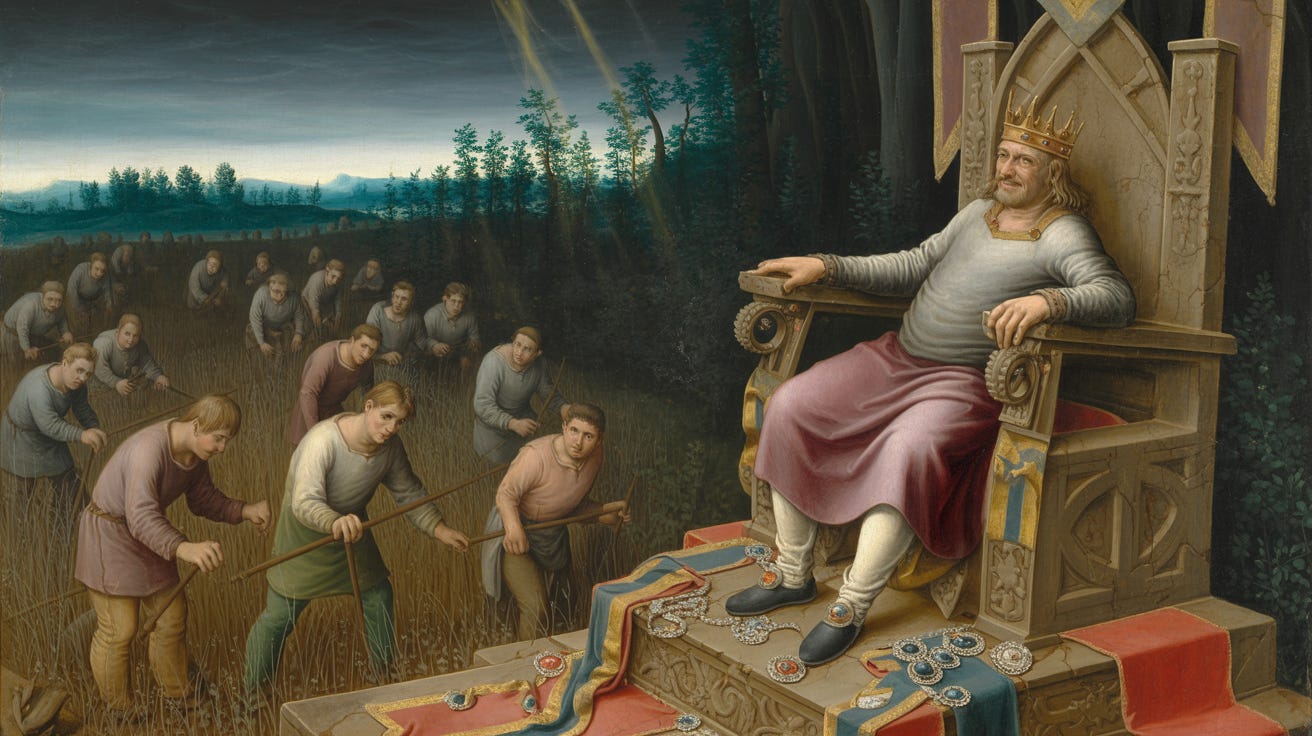
The dichotomy worth making is not merely between society and the state. It is between the productive and a broader criminal class. The state may be the capstone, the talking head and the legislating hand of this class, but the rot goes deeper.
The unholy alliance: who profits from state power?
Consider the fascist regimes of 20th-century Europe. In Italy, the corporate state formally merged corporate and state power, creating an apparatus where nominally private entities acted as arms of the government. In national socialist Germany, leading business elites and corporations like IG Farben and Krupp were not unwilling victims of the state. They were eager partners who profited immensely from slave labor and rearmament, becoming essential components in the machinery of tyranny. Were these “private” companies exercising social power? Of course not. They were exercising state power under a different name. They were equally part of the same criminal class.
The financial engine of state power
And how does this class fund its great projects of war, oppression, and mass control? These are not ventures the average citizen would line up to support with his own earnings. That is where the central banks enter the picture. During World War II, for example, the U.S. Federal Reserve was instrumental in financing the war effort. It did this by “pegging” interest rates at low levels and absorbing huge amounts of government debt, effectively printing the money the state needed. This is not a function of social power but a sophisticated form of counterfeiting. It devalues the savings of the productive to fund the ambitions of the state. The central bank, too, is an essential pillar of the criminal class.
Rothbard was right. The state is a unique, and uniquely dangerous construction. But it is only one part, albeit the most crucial part, of a larger parasitic ecosystem. The real division in society is between those who create value through production and voluntary exchange, and the criminal class that lives by force and fraud. This class includes the state and all its functionaries, but also its cronies, its financiers, and its enablers, who have all chosen to live by preying on the efforts of others.
Forget the staged, scripted WWE-style fights of politicians. The true battle is a silent one, waged daily in every transaction and on every tax form. It is the timeless war between the creator and the confiscator, between society and the criminal class. This is the only conflict that truly matters. Everything else is just noise designed to keep you from noticing who is winning.
If you want to know which side a person or institution belongs to, ask a simple forensic question. Do they gain by persuading you to trade, or by positioning themselves to make you pay up, regardless of consent?
Explore more Popular Philosophy:
Start Philosophy | Definitive Guides | Topics | Today in Philosophy | Podcast
Popular Philosophy publishes definitive guides and essays centered around moral realism, objective truth, Stoicism, ancient philosophy, medieval philosophy, and deeper explorations of the true, the good and the beautiful. Expect carefully researched articles that dissect current event through timeless ideas, for readers who want clear reasoning, primary sources, intellectual honesty and serious philosophy, free from ideological trends and academic fashion.
Subscribe now to support our growing, independent philosophical knowledge base on the timeless questions that shape human life and civilization.