




A recurring spectacle in modern intellectual life is the confident dismissal of metaphysics as superstition, theology as fantasy, and Platonic Forms as a relic of the pre-scientific mind. Yet the same voices often demand institutions that behave as if they possess what their worldview says cannot exist: an authority that can see all, judge all, and bind all.
That irony sits at the center of a recent Popular Philosophy article, which observed that technocratic moralists often end up arguing for a government that must be “omniscient, infallible in its knowledge of truth and goodness” in order to legitimize sweeping control, even while ridiculing the very idea of an omniscient moral source.
This article sharpens the point into a philosophical claim: when metaphysics and moral realism are denied, they do not disappear. They migrate. They reappear as managerial expertise, as “value-neutral” systems that quietly legislate values, and as political projects that require godlike knowledge to justify godlike reach. The result is not the end of metaphysics. It becomes amateur metaphysics with a pungent “... or else” affixed to it.

The anti-metaphysical promise, stated plainly
The 20th century did not merely criticize bad metaphysics. In some of its most influential currents, it tried to abolish metaphysics as a category.
Read the Vienna Circle manifesto, The Scientific Conception of the World (1929), with its ambition to unify knowledge under scientific rigor and treat traditional metaphysical disputation as intellectually suspect.
Or read Rudolf Carnap’s programmatic essay, The Elimination of Metaphysics Through Logical Analysis of Language, which argues that purported metaphysical “statements” dissolve into pseudo-statements once you apply a strict criterion of meaning.
This posture became culturally legible as a kind of moral and epistemic hygiene: stop talking about “ultimate reality,” stop appealing to “objective moral order,” stop invoking the “transcendent Good.” Talk instead about observation, models, procedures, and outputs.
The catch here is simple. Neither politics nor ethics can run on “outputs” alone. Even the materialists’ precious sciences require ends, priorities, and constraints. Those are normative, by necessity. They implicitly make statements about what is real, what is true, and what is good. They cannot be measured in the way temperatures are measured.
David Hume famously noticed the logical jump where writers move from “is” to “ought” without explanation. In the original text of A Treatise of Human Nature, he points out that authors suddenly introduce “ought” propositions after reasoning for a time in ordinary descriptive terms, and he flags this as a change that needs justification.
So when a culture announces “no metaphysics,” it has not solved the is–ought gap. It has usually just decided to smuggle the ought inside something that looks like an is.
The classical compass to truth
Classical and medieval thinkers differed radically, but they shared a restraint that matters here: truth and goodness are not made by decree, because we cannot be the originators, arbiters of things that are greater than ourselves. Instead, they are discovered, participated in, or aligned with.
Plato’s Republic portrays the Good as the condition for intelligibility, not a product of political will. In the famous “sun” analogy, Socrates says the Good is “not essence,” but “far exceeds essence in dignity and power.”
That is a metaphysical claim with political consequences. If the Good exceeds what any governing body can manufacture, then no governing body can honestly claim total moral jurisdiction. The most it can do is approximate justice under the practical constraints of what we, as humans, are capable of knowing and doing.
In the natural law tradition, moral norms are likewise treated as objective constraints on rulers. Aquinas argues that natural law is grounded in practical reason’s orientation to basic goods, and he treats it as something human law should derive from rather than invent at whim.
Whether you read Plato and Aquinas as right or wrong, notice what they do not allow: a moralism that claims legitimacy by self-certification. Politics and ethics, on their account, live under a moral reality they did not create.
When that constraint is rejected, the need for constraint does not vanish. It tends to reappear as something like this: “Our method is the constraint.”
“If the Good exceeds what any governing body can manufacture, then no governing body can honestly claim total moral jurisdiction.”
Laplace’s temptation of total knowledge
Modernity often recasts legitimacy as procedural. If we cannot appeal to a transcendent order, we will appeal to a reliable method.
That sounds humbler than theology. It is not. In its strongest form, it becomes a demand for omniscience.
Pierre-Simon Laplace gives the cleanest statement in its defense. In A Philosophical Essay on Probabilities, he imagines an intelligence that knows all forces and positions at a moment and could, by analysis, render the entire past and future present to its eyes.
Beyond being a scientific fantasy, it is also an irresistible temptation to starry-eyed idealists and do-gooders who would fix all of the world’s problems, if only they were given unchecked power to do so. If a system claims the right to optimize society, then its credibility quietly depends on a Laplacean posture toward human life: full information, full prediction, full control.
And when that posture is unavailable (it is), the response is rarely “we should narrow the scope of our actions and the control we seek.” The response is often “we should expand measurement.”
Godlike governance requires godlike qualities
The deepest critique of technocratic omniscience is not mere moral outrage. It has a solid epistemological foundation.
Friedrich Hayek’s classic essay The Use of Knowledge in Society argues that much of the knowledge needed for coordination is dispersed, local, and time-sensitive. It is not sitting in a central database waiting for experts to query it. It is constantly changing, and the expert can, at best, query outdated knowledge, however comprehensively it may be collected.
This is not just a minor inconvenience. It constitutes a structural, hard limit on knowledge. A planner who wants comprehensive control is implicitly claiming access to a kind of knowledge that, in practice, is distributed across millions of people, embedded in habits, and revealed through adaptive processes.
So when someone insists that a centralized authority should reorganize life at scale, the subtext often reads like this:
We can do this if we can know enough.
We can know enough if we can see enough.
We can see enough if we can measure and standardize enough.
If people resist measurement and standardization, they are “anti-knowledge” obstacles to progress.
At that point, moralism and the politics that go with it, start to take the shape of theology rather than rational, technological, or scientific reasoning. With the exception that, instead of worshiping a deity, they expect to become one when given enough databases and spreadsheets.
“No moral law” becomes “our moral law,” enforced
This adds a second layer to the irony. When objective moral law is denied, the vacuum does not stay empty. Instead, it fills with legislated morality that pretends not to be morality.
You can see this play out in two schools of thought that do not even pretend to like each other:
Hobbes: make the state a “mortal god”
Thomas Hobbes does not hide the logical implications of this dynamic. In Leviathan, he describes the sovereign as a “mortal god” under the immortal God.
Hobbes is candid that political order requires a unifying authority whose commands function as law. If you deny a higher court of appeal, the sovereign becomes, functionally, the highest court.
Far from claiming “no metaphysics,” this transfers metaphysical weight from heaven to the commonwealth.
Nietzsche: create values, become legislators of the human future
Friedrich Nietzsche, in a very different register, imagines “true philosophers” as “commanders and legislators” who say “That is how it should be!” and determine the “where to?” and “what for?” of humanity.
Whether you take Nietzsche as diagnosis or prescription, he names something modern people often do while denying they are doing it: value-creation as a replacement for value-discovery.
Put these together and the irony becomes even clearer.
When “objective moral law” is rejected, the majority of people do not become morally quiet. They embrace moral imperialism. They begin to treat politics as the art of making their values unavoidable.
That is not the end of morality, the defeat of normativity that the rationalists promised to bring to reasoning and policy-making. Essentially, all they have really done is to remove higher appeals to morality, while positioning themselves and their institutions as the final arbitrators of it. And so, we start to develop a clear view of why their rejection of metaphysical morality so easily becomes zealous and coercive.
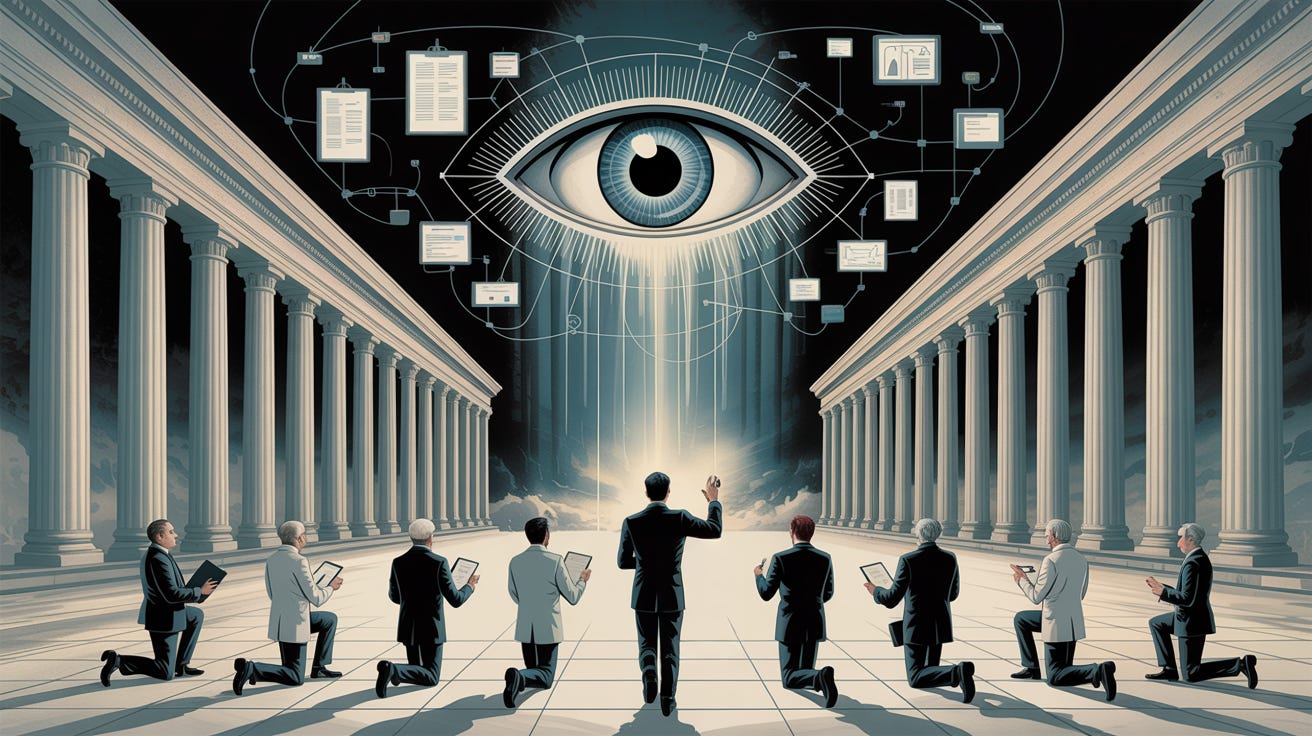
Atheists crave their own omnipotent deity
When pointing fingers at the parties most guilty of this, the target should not merely be “technocrats,” but a broader demographic of modern atheist, rationalist materialists who treat metaphysics as epistemic childishness. The type that can be spotted gratuitously mocking theological concepts of divine omniscience and absolute moral certainty, only to turn around and demand a secular state capable of governing human life through these very same means.
If you want empirical support for using that shorthand in the American context, Pew Research states that among U.S. registered voters, 84% of atheists identify as Democrats or lean Democratic.
Now, those numbers do not prove a metaphysical thesis. They do something more modest and more relevant: they justify treating atheism, in the current Anglosphere political ecology, as unusually concentrated inside the coalition that most often argues for expansive governance by expert administration.
Once you grant that cultural fact, the philosophical question becomes unavoidable: what replaces metaphysics and religion when they are rejected, but moral certainty and comprehensive control remain desired?
Often, the answer is “the system.”
The quiet return of metaphysics under new names
There is a fatal irony at play when one digs down to the core of anti-metaphysical rationalist posturing.
Even the most aggressively anti-metaphysical schools of thought usually end up depending on metaphysical assumptions. It just calls them something else.
“Value-neutral expertise” quietly assumes a metaphysics of the person, because it must decide what counts as harm, welfare, dignity, and progress. Someone, somewhere, is put in charge of deciding which ends are desirable and which ones are not.
“Evidence-based policy” quietly assumes a theory of the good, because evidence does not tell you which goals are worth pursuing or worth sacrificing for. Someone, somewhere has to make the leap from descriptive accounts of observable reality to normative claims about what should be done with the information.
“Trust the science” often collapses into trust in institutions, calibration chains, and standards bodies, which are human practices that presuppose norms about honesty, responsibility, and the value of truth.
Even the Stanford Encyclopedia of Philosophy notes a self-referential tension in strong anti-metaphysical verificationist ambitions, since the criterion itself is not something you can verify the way you verify a lab measurement.
So the secular, rationalist world does not become metaphysics-free. It becomes subjugated to metaphysics that refuses to admit it is metaphysics.
And that refusal is precisely what makes it dangerous, because it lets moral choices masquerade as technical necessities.
The secular, rationalist world does not become metaphysics-free. It becomes subjugated to metaphysics that refuses to admit it is metaphysics.
The “God-shaped” argument for total authority
Now we can state the irony of the anti-metaphysical worldview in its essential form.
Modern intellectuals tend to deny transcendent truth and objective moral law, treating them as illegitimate “external” authorities. Yet they also demand political arrangements that require omniscience and moral certainty to justify comprehensive control.
Those demands implicitly rely on the very attributes they reject as real in any authoritative form, namely something approximating omniscience about truth and goodness.
When omniscience fails (it will), they are either forced to scale back authority or, more commonly, they scale up coercion and surveillance to approximate omniscience.
In other words: every anti-metaphysical project ends up haunted by a metaphysical requirement. It becomes an argument with a God-shaped hole in it.
Plato’s warning about mistaking shadows for reality is relevant here, not because everyone needs to become a Platonist, but because modern institutions are especially good at manufacturing shadow worlds to fixate upon: dashboards, metrics, legibility schemas, risk scores, compliance categories. The temptation is to treat what can be observed as the totality of what is real and true.
The older philosophical traditions did not ban measurement, but they rightly restrained hubris. They insisted that rulers and experts cannot be the originators of the Good, effectively preventing rulers from foolishly claiming a moral blank check backed by imperfect knowledge.
What is required for reason to be rational
Does this mean we are doomed to choose between superstition and faith in what we cannot know on the one hand, and ascribing divine powers to man-made institutions on the other? Hardly.
There are two tools any serious thinker can utilize to place himself squarely outside of this dichotomy of imperfect metaphysical commitments:
The first of which is epistemic humility. Treat prediction and control as limited, especially in complex social life. Hayek’s dispersed-knowledge insight is not an ideological posture restricted to the world of macroeconomics. His observation marks a basic fact about the limits of knowledge in empirical reality.
The second tool is moral constraint. Admit that governance needs limits that cannot be issued by the governors themselves. Whether these are grounded in Aquinas-style natural law, in a Platonic realism about the Good, or even in a secular moral realism, the critical restraint stays the same: some things are wrong, even if the model says they ‘work’.
Once you accept those two commitments, the political fantasy of practical godhood loses its glamour. The state becomes what it should have been all along: a fallible tool under moral restraint, not a substitute deity that demands total visibility and total obedience.
Explore more Popular Philosophy:
Start Philosophy | Definitive Guides | Topics | Today in Philosophy | Podcast
Popular Philosophy publishes definitive guides and essays centered around moral realism, objective truth, Stoicism, ancient philosophy, medieval philosophy, and deeper explorations of the true, the good and the beautiful. Expect carefully researched articles that dissect current event through timeless ideas, for readers who want clear reasoning, primary sources, intellectual honesty and serious philosophy, free from ideological trends and academic fashion.
Subscribe now to support our growing, independent philosophical knowledge base on the timeless questions that shape human life and civilization.