



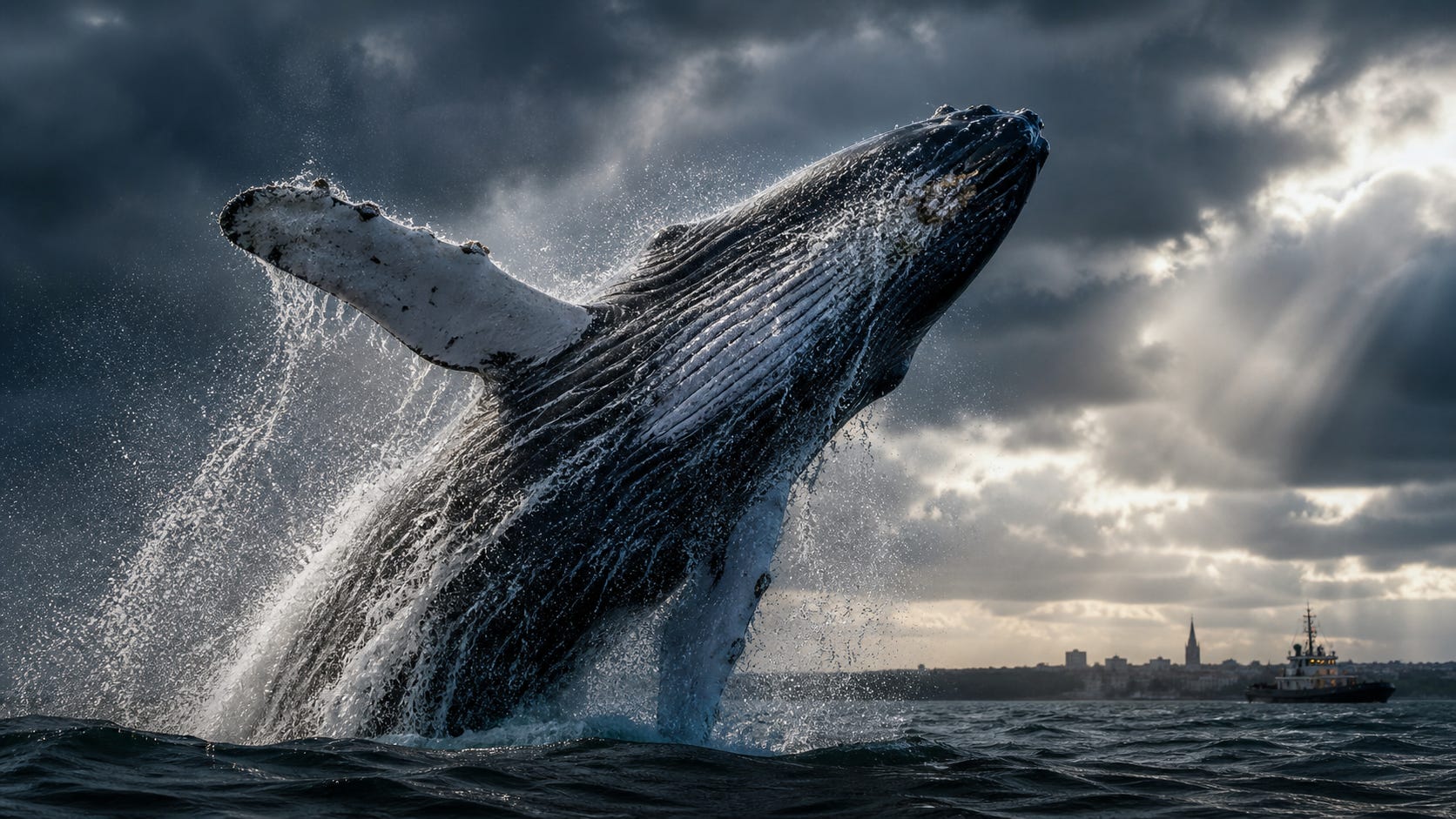
For weeks, Timmy the humpback whale lay trapped in the wrong sea.
He was a young whale, stranded far from the Atlantic, caught in the shallow, brackish waters of the Baltic. Humpbacks belong in the open ocean. They are creatures of depth, distance, migration, song, cold water, feeding grounds, and long movement through the world. Timmy had wandered into a place that was slowly killing him.
By early April 2026, his condition had visibly deteriorated. Reports described irregular breathing, damaged skin, repeated strandings, injuries, and the debilitating effect of the Baltic’s low salinity. Experts warned that he was unlikely to survive. Several official efforts had already failed. The state-sponsored rescue attempt was suspended on April 1. Many authorities, experts, and conservation voices were ready to let him die. Some argued this would be the humane course. Others framed it as nature taking its course. Euthanasia, too, was apparently ruled out as impractical. In plain terms, Timmy could have been left to suffer for weeks until his body finally gave out.
Then two private citizens stepped in.
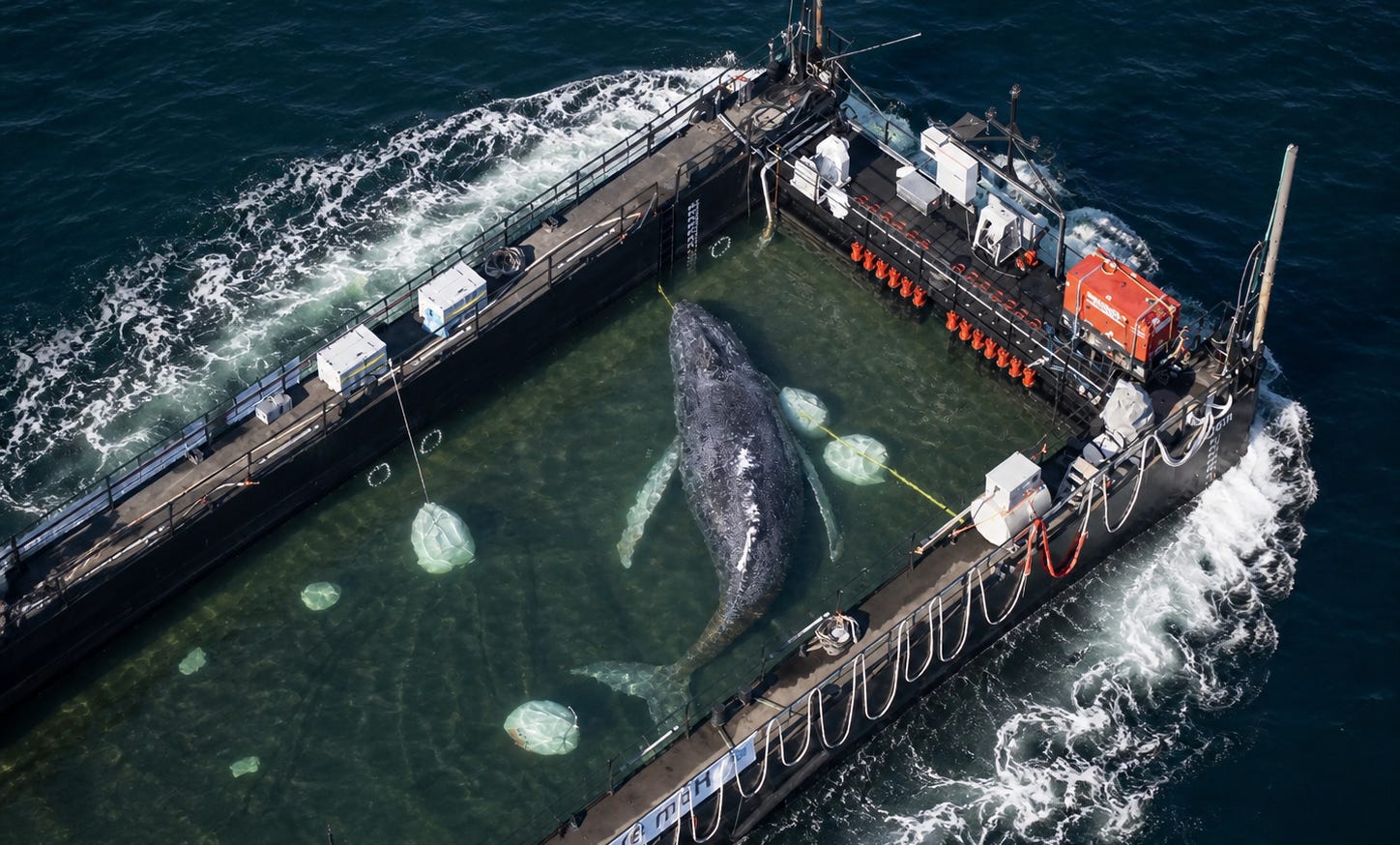
German entrepreneurs Karin Walter-Mommert and Walter Gunz funded an extraordinary rescue attempt. They assumed the cost, the responsibility, and the moral burden. Their plan was not modest. Timmy would be guided onto a specially prepared barge, treated, transported hundreds of kilometers, and released into the North Sea, where he might have a chance of finding his way back toward the Atlantic. Critics called the plan reckless. The International Whaling Commission reportedly called it “inadvisable.” The German Oceanographic Museum warned that the whale should be left to die in peace. Greenpeace, which had been involved in earlier rescue efforts, criticized the private operation and said it would focus instead on broader ocean-protection campaigns.
But the entrepreneurs gave a different answer. Gunz put the moral case with disarming simplicity: “At least if you try something you have a chance of saving it.” Walter-Mommert said the whale “fought and wanted to live.” After Timmy was finally loaded onto the barge, Gunz reportedly wept and said, in translation, “What is most valuable? Life!”
That sentence is the whole story.
“What is most valuable? Life.”
How private citizens gave Timmy the whale a chance to live
There is a temptation, in stories like this, to distribute credit evenly. Officials were involved. Volunteers helped. Fire brigades and local workers kept the whale wet. Ministers eventually approved the plan. Veterinarians had to assess whether transport was even possible. None of that should be erased.
But it would be dishonest to miss the central fact: the decisive rescue was privately driven and privately funded after official efforts had been suspended. The state had tried and failed. The experts had largely concluded that Timmy was doomed. Major institutional voices were prepared to watch him die. The final act of rescue came from private people who refused to accept slow death as the morally superior outcome.
That distinction matters because it exposes a difference in moral imagination.
The institutional response was managerial: Timmy became a risk problem, a prognosis problem, a liability problem, a procedural problem, a reputational problem, perhaps even a “nature must take its course” problem. The entrepreneurs saw the same suffering animal and asked a simpler question: can we help him live?
This is not a sentimental distinction. It hits a metaphysical mark that bureaucrats all too often miss.
To see Timmy as a life worth saving is to see him as more than biological material. It is to see him as a being whose life has its own good. A whale is not a floating corpse-in-waiting. A whale is not a data point. A whale is not a public-relations event for experts, institutions, or environmental organizations. A whale is a living creature ordered toward its own flourishing as a whale.
That is the philosophical language for something modern institutions keep forgetting: teleology.
What Timmy the whale reveals about the purpose of life
Teleology is the study of ends, purposes, and final causes. In Aristotle’s philosophy, nature is not an accidental heap of matter. Living beings are intelligible through what they are ordered toward. An acorn is understood through the oak. An eye is understood through sight. A human life is understood through the good at which human action aims. Aristotle opens the Nicomachean Ethics with the claim that every art, inquiry, action, and choice aims at some good, and he asks what the highest human good must be.
A whale, likewise, is not understood by listing its chemical composition. It is understood as a form of life. Its good is not identical to ours, but it is still real. It is ordered toward swimming, breathing, feeding, migrating, mating, communicating, and living according to the nature of a whale. When Timmy lay stranded in the Baltic, what we witnessed was not merely unfortunate biology. We witnessed a creature violently displaced from the conditions of its own proper life.
This is why the question “should we help?” cannot be answered by protocol alone.
A teleological view of life begins with the recognition that living things have goods proper to them. Their flourishing can be aided or frustrated. Their life can be protected or destroyed. Their suffering can be met with mercy or with procedure.
Aquinas gives this moral intuition a sharper form in his account of natural law. The first principle of practical reason is that good is to be done and evil avoided. From there, Aquinas argues that the natural inclination toward the preservation of life belongs to natural law. Every substance seeks to preserve its own being. Life is not an arbitrary preference imposed by human sentiment. It is one of the most basic goods through which practical reason first encounters the moral order.
That does not mean every rescue attempt is wise. It does not mean death can always be avoided. It does not mean human beings must always intervene in nature. But it does mean that life is not morally neutral. Suffering is not morally invisible. The drive of a creature to live should command our attention.
Albert Schweitzer called this “reverence for life.” His ethic was imperfect, but his central insight was powerful. He argued that ethical life begins when one recognizes the will-to-live in another being and responds with active reverence. In his words, “Every life is sacred.” The phrase can be abused when torn from prudence, but its core remains true: civilization begins in the refusal to treat living beings as disposable matter.
This is what Walter-Mommert and Gunz saw.
They saw a wounded whale that still wanted to live. They saw a creature fighting, breathing, struggling, and suffering. They did not require a committee to tell them that life is precious. They did not confuse moral seriousness with official fatalism. They acted because they could not stand to watch him slowly die.
That instinct is one of the foundations of civilization.
When bureaucracy learns to manage decline instead of saving life
The most disturbing part of the Timmy story is not that some experts doubted the rescue would work. They may have been right about the risks. The whale’s long-term survival remained uncertain after release. Reports noted serious injuries, deteriorating health, and the possibility that the rescue might prolong suffering rather than save him. All these things may very well be true.
The disturbing part is the ease with which institutional actors seemed able to metabolize his suffering into professional resignation: let him die in peace. Let nature take its course. Focus on the broader system. Do not risk a failed rescue. Do not attempt the unprecedented. Do not act unless the process guarantees success.
That attitude sounds humane until one remembers the actual animal. Timmy was not peacefully dying in the vacuum of outer space, somewhere far beyond human reach. He was lying in front of civilization, injured and visible, surrounded by people with boats, tools, money, equipment, veterinary knowledge, media access, and state power. Far from being hidden from our attention, he was presented to us as a test.
And much of official civilization failed that test.
The modern institution is almost always better at explaining why it cannot do good than at actually doing it. It can produce a risk assessment, a cautionary statement, a funding review, an ethical objection, a jurisdictional explanation, and a public-facing statement of concern. What it often cannot produce is the moral energy to save the thing directly in front of it.
This is a familiar bureaucratic disease. Robert K. Merton described how bureaucracies can displace attention from ends to means. Rules begin as instruments, then become sacred objects. The original purpose fades. Compliance becomes the real telos. Specific cases are absorbed into general categories. Living reality is forced into administrative form.
Timmy’s case had exactly that feel. The living animal was surrounded by people whose institutional languages had made direct moral action difficult. The whale became a case, a risk, a scientific judgment, an ecological talking point, a welfare dilemma, a media problem, and an occasion for caution.
The entrepreneurs cut through that fog. They saw the end: save the whale if possible. Give him a chance. Respect life.
More on moral philosophy:

Modern institutions lost sight of human flourishing
This is where Timmy becomes more than a whale.
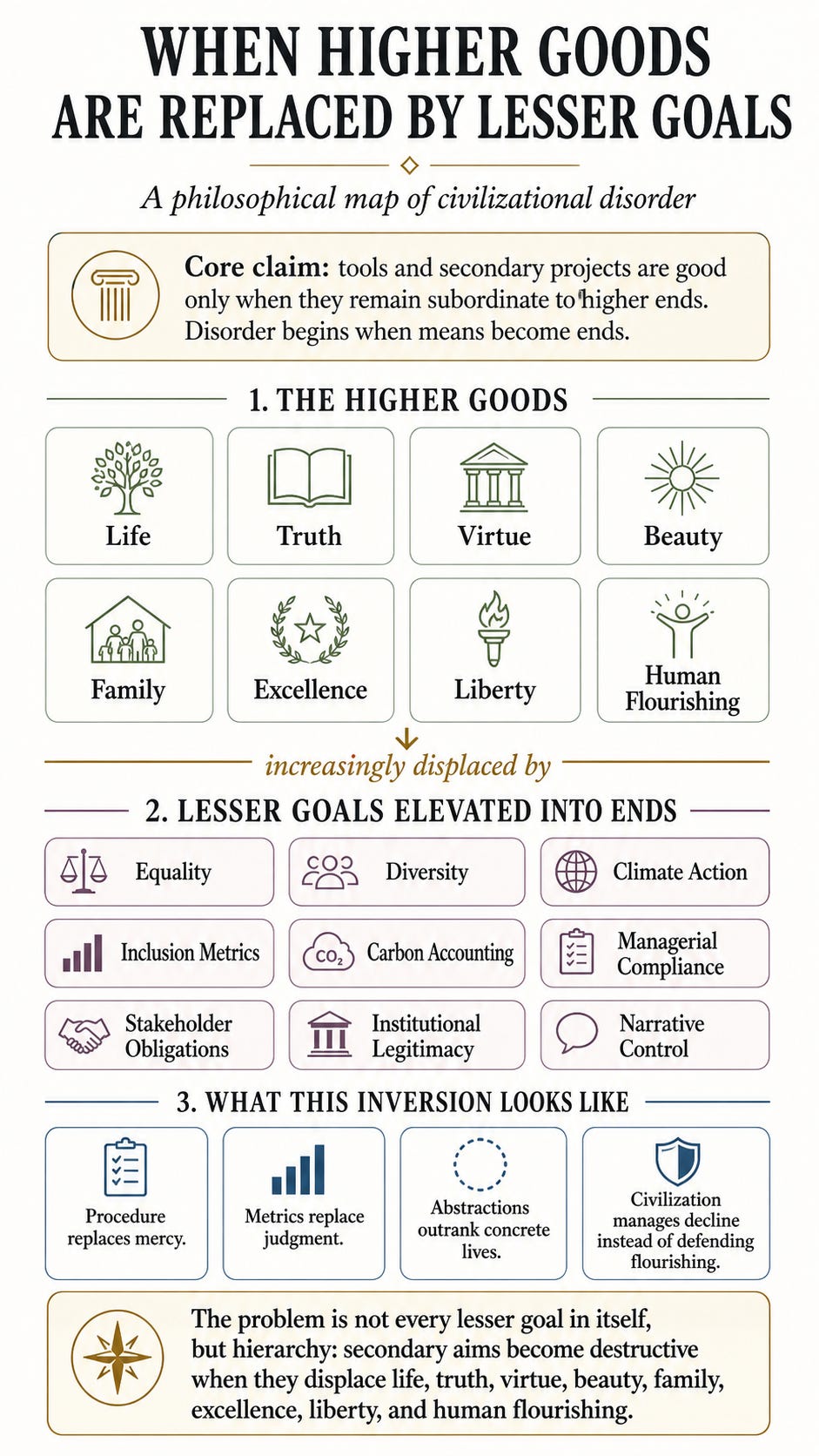
Every civilization has a metaphysical telos, whether it admits it or not. A society reveals what it worships by what it protects, what it sacrifices, and what it treats as non-negotiable.
A healthy civilization places life, truth, virtue, beauty, family, excellence, liberty, and human flourishing near the center of its moral imagination. These are not mere preferences. They are civilizational goods. They are the conditions under which human beings become more fully human.
Our institutions increasingly organize themselves around lesser goals.
Equality. Diversity. Climate action. Inclusion metrics. Carbon accounting. Managerial compliance. Abstract “stakeholder” obligations. Institutional legitimacy. Narrative control. These are treated as ends in themselves rather than subordinate tools subject to judgment by higher goods.
The problem is not that every concern under those labels is meaningless. The problem is hierarchy. A civilization becomes disordered when secondary projects displace primary goods. Equality becomes destructive when it undermines excellence, family, inheritance, achievement, or natural difference. Diversity becomes destructive when it dissolves trust, continuity, and shared moral culture. Climate politics becomes destructive when it subordinates energy, prosperity, industry, food security, and ordinary human flourishing to a bureaucratic theory of planetary management.
These projects all share a common feature: they are abstractions that can be pursued while concrete lives get worse.
A town declines, but the policy meets equity goals. Energy becomes unaffordable, but the climate plan advances. Schools decay, but the diversity framework expands. Families struggle, but the institutional report celebrates inclusion. Farmers are crushed, industries are regulated into paralysis, public order frays, and ordinary people become poorer, colder, more surveilled, more dependent, and less free. Yet the bureaucracy congratulates itself because its chosen abstractions are moving in the approved direction.
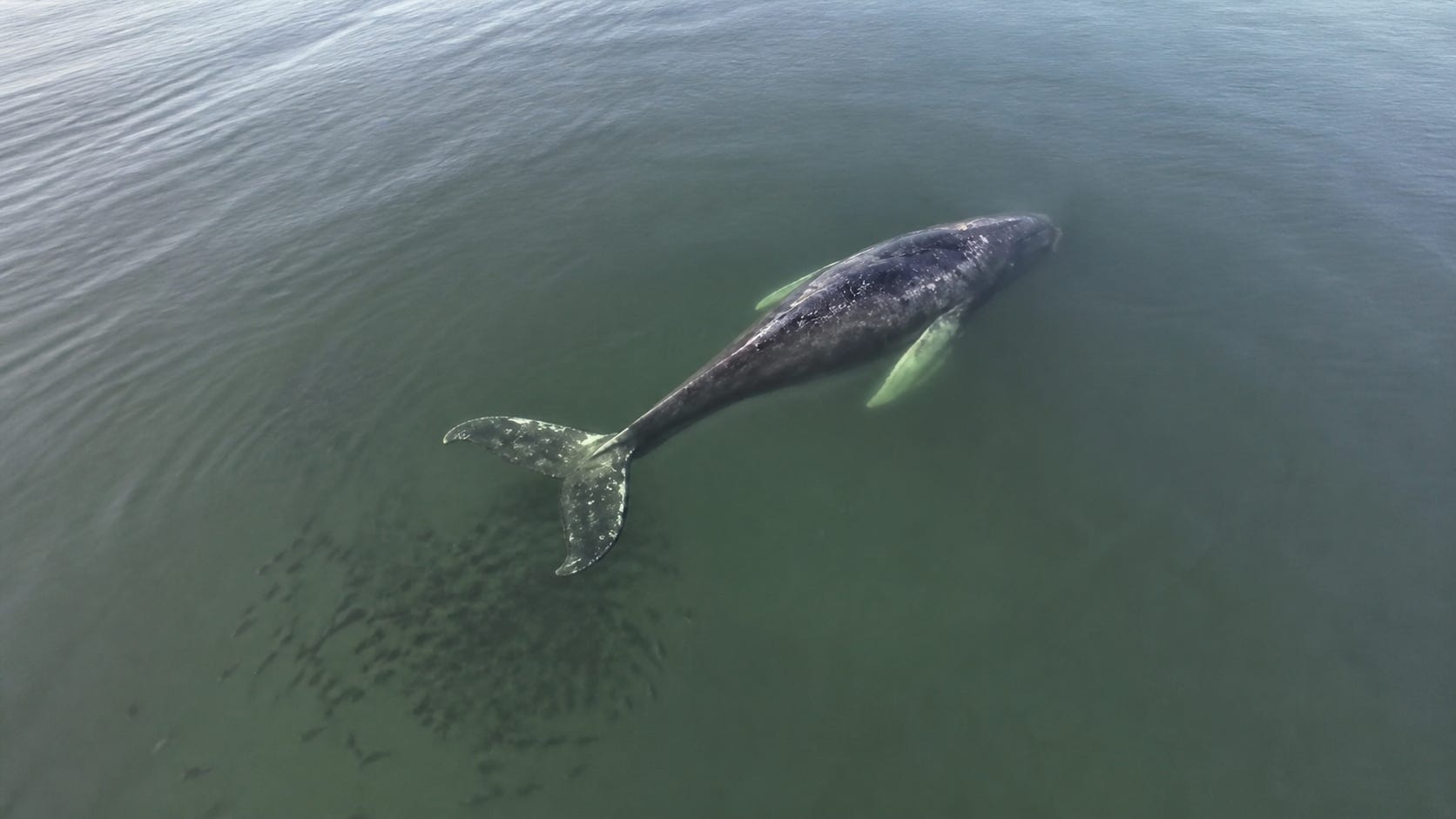
Timmy’s body in the Baltic was a symbol of that inversion.
The whale was life itself, stranded in the shallows of a civilization that has forgotten what life is for. Around him stood institutions fluent in concern yet hesitant before sacrifice, procedure-rich yet telos-poor, capable of managing decline but unable to revere the struggling creature in front of them.
The question is not whether every expert was wrong. The question is what kind of civilization becomes comfortable watching life wither while explaining why intervention is imprudent.
Share this publication with readers who want philosophy that confronts the moral crisis of our age.
What past whale rescues teach us about moral courage
The history of stranded whales gives a useful comparison.
In 1985, Humphrey, the humpback whale, entered San Francisco Bay and swam up the Sacramento River. Public concern grew intense. Volunteers, scientists, the Coast Guard, and federal officials became involved. Crews eventually used recordings of humpback feeding sounds and other techniques to lure him back toward the ocean. The Los Angeles Times later described how public empathy helped pressure the federal government into joining the rescue.
Humphrey stranded again in 1990. This time, volunteers kept him wet, divers placed a harness around him, and a Coast Guard vessel helped pull the forty-ton whale free from a tidal flat. Thousands watched. The rescue was low-budget, improvised, and intensely public. Afterward, a Marine Mammal Center biologist said Humphrey had galvanized public interest and drawn people closer to marine life.
These older cases complicate the do-nothing side of this story in an important way. Governments and institutions are not incapable of helping. They can act when public moral pressure, local knowledge, voluntary energy, and practical courage force them back toward their proper function.
But that is exactly the point.
Institutions do not usually generate moral vitality. They borrow it. They channel it. Sometimes they obstruct it. Sometimes they follow once others lead. In Humphrey’s case, public concern moved the system. In Timmy’s case, private citizens moved the system after official efforts were suspended and expert consensus leaned toward surrender.
This pattern is hard to ignore. Moral initiative often begins outside the institutions.
Timmy the whale as a warning for civilization
Timmy’s fate is still not a fairy tale. Releasing him into the North Sea did not guarantee his survival. Experts were right that a stranded, injured, undernourished whale faces brutal odds. The private rescuers may have bought him life, or they may only have spared him a more visible death. We should be honest about that uncertainty.
But moral action is not invalidated by uncertainty.
In fact, uncertainty is where moral character becomes visible. It is easy to help when success is guaranteed, cheap, applauded, and institutionally approved. The harder test comes when the good is fragile, the outcome uncertain, the experts divided, and failure possible. That is when we learn who still believes life is worth defending.
Timmy represents a question our civilization does not want to answer.
What do our ruling institutions really think about life? About suffering? About prosperity? About the public? About civilization? About human flourishing itself?
Because the whale is not only a whale. He is also the citizen crushed under policies designed for abstractions. He is the farmer ruined for climate targets. He is the child sacrificed to ideological schooling. He is the family priced out of stability by a managerial class that treats their life as a variable in a model. He is the productive worker taxed, regulated, monitored, and lectured by institutions that claim to serve humanity while making human life less livable.
He is the future, stranded in shallow water, surrounded by experts explaining why rescue is unrealistic.
Are these really the people we want to trust with civilization?
The ones who see decline and call it management? The ones who see suffering and are content with “monitoring the situation”? The ones who see life fighting to live and call intervention “inadvisable”?
Or do we still have enough metaphysical sanity to recognize the older truths we used to live by?
Life is good. Flourishing is good. To act for life is better than to supervise decay. A civilization worthy of the name must be ordered toward the protection and elevation of life, not toward the smooth administration of its decline.
Walter-Mommert and Gunz did not write a philosophical treatise. They did not need to. They saw a suffering animal and acted from reverence. Yet, they answered the teleological question more clearly than many of our institutions could.
What is most valuable?
Life.
What did Timmy’s rescue reveal to you about our institutions and their view of life?
Explore more Popular Philosophy:
Start Philosophy | Definitive Guides | Topics | Today in Philosophy | Podcast
Popular Philosophy publishes definitive guides and essays centered around moral realism, objective truth, Stoicism, ancient philosophy, medieval philosophy, and deeper explorations of the true, the good and the beautiful. Expect carefully researched articles that dissect current event through timeless ideas, for readers who want clear reasoning, primary sources, intellectual honesty and serious philosophy, free from ideological trends and academic fashion.
Subscribe now to support our growing, independent philosophical knowledge base on the timeless questions that shape human life and civilization.
The private rescuers understood something simple and profound: life is worth defending, even when success is uncertain.
What do you think Timmy’s rescue revealed about modern civilization?