




John Gorrie wanted to cool the sick.
That is where this story should start.
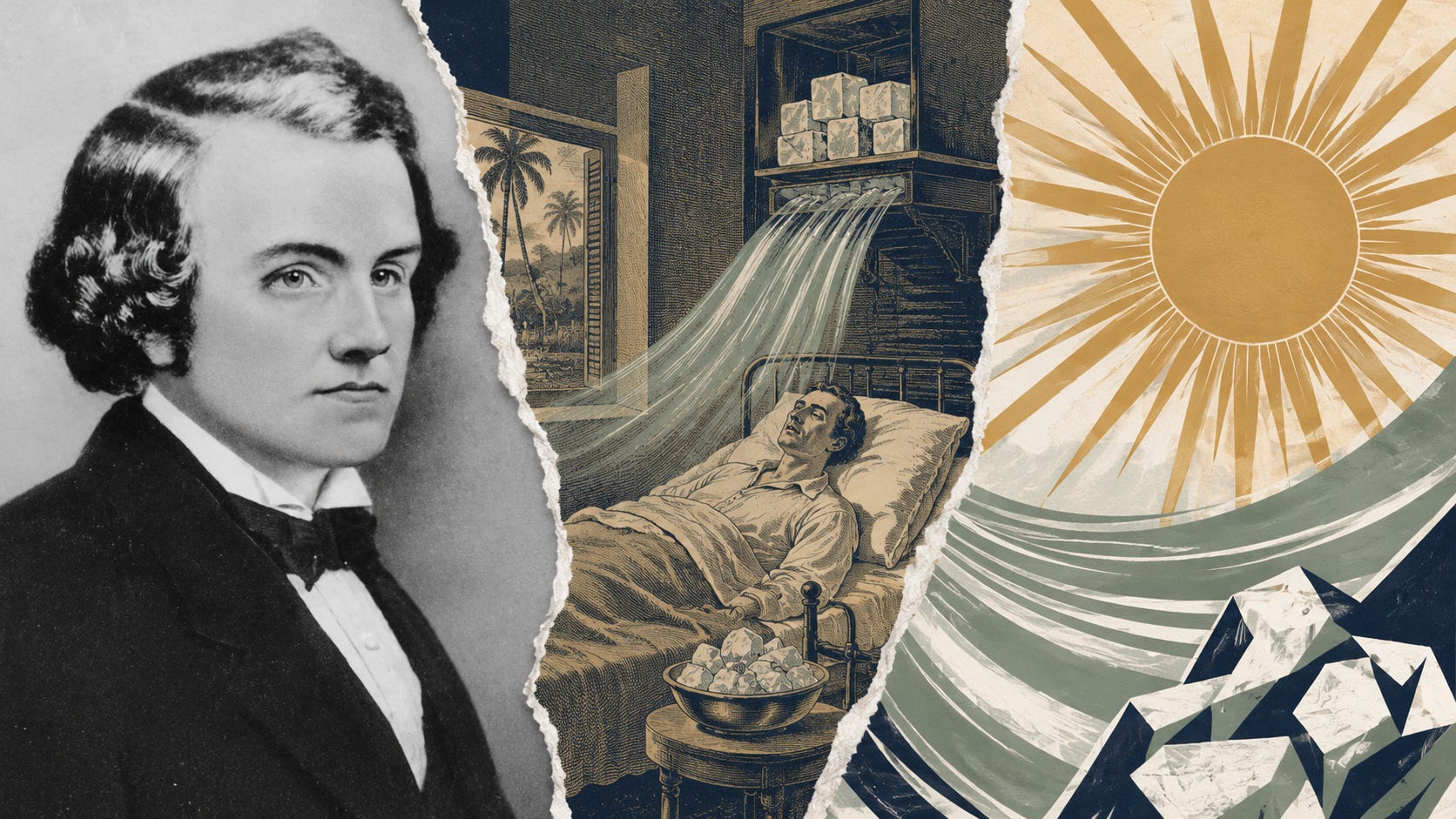
A physician in Florida during the age of yellow fever, Gorrie believed artificial cooling could help patients survive brutal heat. His invention was not born from decadence, consumerism, or indifference to nature. It was born from mercy. In 1851, Gorrie received the first U.S. patent for a mechanical refrigerating or ice-making machine, a device that used expanding air to turn water into ice. The Smithsonian notes that Gorrie successfully used ice and cooled air in the treatment of tropical diseases, and that Florida later honored him with a statue in the U.S. Capitol.
The moral meaning of the invention was obvious: heat threatened the body and human ingenuity came to the rescue.
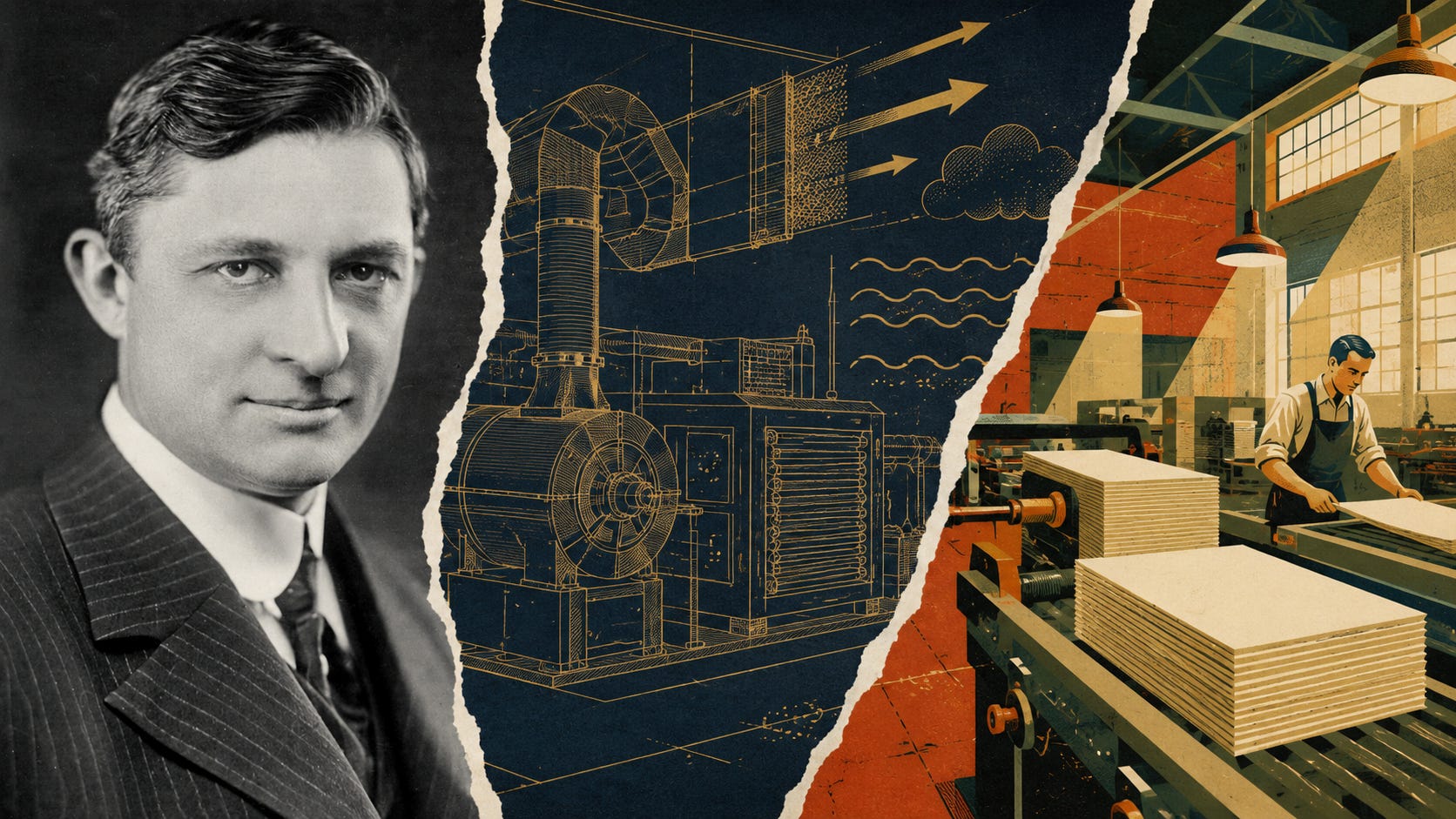
Air conditioning as we know it today, controlling both temperature and humidity, is usually credited to Willis Haviland Carrier. In 1902, after a Brooklyn printing plant struggled with heat and humidity that distorted paper and ruined color alignment, Carrier built the first modern air-conditioning system. His 1906 patent for an “Apparatus for Treating Air” helped make possible the controlled indoor climates that hospitals, laboratories, factories, archives, schools, offices, shops, and homes now take for granted.
Carrier was honored accordingly. He was inducted into the National Inventors Hall of Fame in 1985 for the “Air Conditioner.” He received the John Scott Medal “For the Invention of Processes and Apparatus for Air Conditioning and Refrigeration.” In 1934, he received the ASME Medal, which the American Society of Mechanical Engineers describes as its highest award for “eminently distinguished engineering achievement.”
Western civilization praised Carrier because he made the atmosphere of buildings more answerable to human purpose.
That moral world now feels strangely distant. In Gorrie’s and Carrier’s age, making heat less dangerous and work more bearable would be recognized as an obvious human good. In ours, the same act increasingly requires moral apology.
That contradiction reveals a deeper philosophical question. What is electricity for?
The teleology of power
Aristotle’s account of causality included the final cause, the telos, meaning the end or purpose for the sake of which a thing exists or is done. In the Physics, Aristotle distinguishes among several kinds of explanation, including “that for the sake of which” a thing is done. To understand a house, one must understand shelter. To understand medicine, one must understand health. To understand electricity, one must ask what human goods it ought to serve.
A purely material account of electrons, turbines, grids, substations, meters, and appliances cannot answer that question. It tells us how power moves. It does not tell us what power is for.
This is not an abstract academic puzzle. A civilization reveals itself by how it ranks goods. If electricity is ordered toward human flourishing, then heat relief for the vulnerable is one of the clearest cases for the grid’s existence. If electricity is ordered toward ideological performance, then the household must be disciplined until it conforms. If electricity is ordered toward bureaucratic control, then data centers will be fed while bedrooms are rationed. If electricity is ordered toward decarbonization detached from concrete human goods, then the living body can be sacrificed to an abstraction.
By human flourishing, we should mean something concrete: life, health, sleep, household stability, productive work, study, care for children, care for the elderly, freedom, physical integrity, and the ordinary conditions under which embodied rational creatures live well. These goods are not luxuries. They are the goods civilization, at least nominally, exists to secure.
The air-conditioning debate brings this buried question into the open: does the energy system exist to serve human beings, or are human beings subordinated to the system’s officially preferred projects?
Air conditioning as forbidden comfort
In late June, Europe experienced what the World Meteorological Organization described as a record-breaking heat wave, with western Europe experiencing its hottest June on record. The WMO said the heat affected human health, infrastructure, ecosystems, agriculture, and labor productivity. The UK Met Office said Britain broke its June maximum-temperature record for a third consecutive day, reaching a provisional 37.3°C at Santon Downham in Suffolk on June 25. France reportedly recorded its hottest day ever, with Paris reaching 40.3°C.
The human consequences were not theoretical. The Guardian described French residents struggling in heat-trap buildings, especially in low-income housing estates, and quoted one woman in a seventh-floor flat outside Paris saying she had thought, “I’m going to die.”
Schools were strained badly enough to expose the weakness of Europe’s built environment. In Britain, more than 1,000 schools had reportedly closed, while in France, reportedly more than 13,500 schools and educational institutions had adapted their operations. Some closed fully. Others closed partly. Others urged parents to keep children home.
By June 28, around 1,000 additional deaths had been reported in France during the peak of the heat wave, with the national public health agency saying that 85 percent of those deaths deaths involved people aged 65 and above.
Europe is unusually vulnerable because air conditioning remains rare by the standards of other developed regions. The International Energy Agency says air-conditioner ownership in Europe remains relatively low, at about 20 percent, while an earlier IEA analysis notes that more than 90 percent of households in the United States and Japan have air conditioning. The result is not some heroic victory of ecological restraint over the ever-changing forces of nature. It is elderly people, sick people, children, workers, and apartment dwellers trapped inside buildings designed for a cold climate and governed by an even colder morality.
Europe’s establishment response has followed a distinct pattern. The need for air conditioning is conceded as a last resort for the vulnerable, then quickly surrounded by guilt, moral disapproval, and suspicion. France’s climate debate has offered some of the clearest examples. French “climate experts” treat air conditioning as “maladaptation”, a response to climate change that worsens the conditions it tries to relieve. Jean-Luc Mélenchon was quoted saying, “We must absolutely not install air conditioning everywhere.” The same article reported that in a 2021 poll, nearly six in ten French respondents said they would rather “suffer from the heat” than install air conditioning... for environmental reasons.


Spain has gone further with legal thermostat limits. In 2022, the Spanish government approved an energy-saving plan under which cooling in many public, administrative, and commercial buildings may not be set below 27°C, while heating may not be set above 19°C. The same package required measures such as automatic door closures and switching off shop-window lights at 10 p.m. The European Environment Agency presents such limits as good practice, saying that setting air-conditioning thermostats to 27°C instead of 22°C can halve energy consumption.
In the UK, London’s planning framework has long moved in the same direction. The London Plan’s cooling hierarchy aims to reduce the need for active cooling, and the Greater London Authority says air conditioning systems are a resource-intensive form of active cooling, increasing carbon dioxide emissions and emitting heat into surrounding areas. During the June 2026 heat wave, the British government felt compelled to clarify that air conditioning is not banned in homes, and that small domestic systems often do not require planning permission if they do not materially affect the building’s external appearance.
That clarification was welcome. But the fact that it was needed at all was revealing. Citizens have learned to suspect that active cooling belongs to the category of things the state may obstruct, shame, regulate, or grudgingly tolerate.
The anti-waste argument
Reasonable arguments can be made for the implied case against waste and inefficiency.
Bad architecture should not be rewarded. Perhaps a city of unshaded glass towers should not compensate for poor design by consuming electricity without limit. Refrigerants can leak. Inefficient portable units can be power-intensive. Poorly planned cooling can probably intensify heat in very dense streets. Peak demand can strain grids. It is not far-fetched to insist that a prudent society should incorporate shade, ventilation, insulation, trees, reflective surfaces, shutters, and passive cooling into its cities.
The International Energy Agency itself warns that rising cooling demand can test electricity systems, especially during heat waves. It points toward efficiency, better equipment, demand response, and planning. That is a real engineering problem that would, in a well-designed energy system, be addressed with real engineering answers.
Hardly anyone argues that every room should be cooled to absurdly low temperatures. Nor would anyone claim there is any moral duty to waste energy. The question is whether ordinary people may use technology to protect life, sleep, health, family order, and productive labor without being morally scolded by institutions planning far larger electricity demands for their own preferred projects.
An honest, good-faith, rational approach to these real problems would balance energy costs against human benefits. The new moralism, however, asks a very different question.
The Guardian’s theology of heat
A Guardian column by Emma Beddington captures this new moral order with unusual clarity. Her complaint is not merely that air conditioning consumes energy, that inefficient systems should be improved, or that better urban design is needed. She calls air conditioning “philosophically problematic” because, in her words, “cooling offers comfort, making the unbearable bearable.” She then argues that when individuals can buy a private zone of cool air, they may no longer fully feel the heat, and consequently the “screaming urgency” of climate action may recede.
If anything, she did an excellent job of condensing the broader belief system that dominates establishment politics and policy into a few choice sentences.

From any humane perspective, “making the unbearable bearable” would describe the essential work of medicine, architecture, clothing, heating, refrigeration, sanitation, and every other art by which human beings make a hostile world more habitable. “Making the unbearable bearable” would be a badge of honor. In the new climate moralism, it becomes an indictment.
The issue is not that Beddington denies every legitimate use of air conditioning. She explicitly concedes that the very old, the very young, and the vulnerable should be kept cool. She even admits that she owns a small freestanding unit herself. That makes the column more revealing, if anything. The argument against air conditioning does not come from a crude Luddite perspective. It comes from an active desire to preserve discomfort as a form of political instruction.
The older technological imagination asked how human beings could use knowledge to lessen suffering. Gorrie asked how the sick might be cooled. Carrier asked how indoor air might be controlled so that human work and production would no longer be hostage to humidity and heat. The new climate moralist imagination worries that lessening suffering might weaken ideological mobilization for its preferred political agenda.
There is an almost sacramental logic here. Heat becomes punishment, cast down upon humanity by Mother Gaia. Sweat becomes a form of participation in collective penance. Discomfort becomes the pedagogy through which citizens are meant to learn the connection between private life and public doctrine. The citizen must feel the world burning so that the political project retains its emotional force. A machine that interrupts that experience becomes a target because it offers relief before permission has been granted by the cause.
This is why the air-conditioning debate cannot be reduced to a good-faith debate about energy impact. The issue is not whether cooling should be efficient. All sides agree that it should. The issue is whether relief from heat is treated as a human good or as an ideological obstacle.
When a society starts to demonize comfort because comfort may reduce ideological urgency, it has already subordinated the human body to propaganda.
The approved megawatt
Strikingly, Western governments are not opposed to electricity, or to wasting it. In their observable practice, they are opposed to the “wrong” people using it for the “wrong” purposes.
First, the European Commission says openly that electricity’s share of final energy consumption must rise. In 2024, renewables accounted for 47.5 percent of gross electricity consumed in the EU, but electricity represented only 23 percent of final energy consumption. The Commission says that share must grow to meet “climate targets,” and it points to a 32 percent reference target for electricity’s share by 2030. Its electrification agenda is aimed at transport, industry, and buildings.
This means electricity is not dirty when it powers an electric-vehicle mandate. It is not dirty when it heats homes as part of a politically favored heat-pump boondoggle. It is not dirty when it powers battery systems, grid-responsive devices, industrial electrification, digital monitoring, and the administrative machinery of the energy transition. Electricity becomes dirty when a family uses it to cool a bedroom.
The same pattern appears regarding data centers. In 2024, the British government designated UK data centers as Critical National Infrastructure, placing them alongside energy and water systems. The government stated that data centers are “the engines of modern life,” that they power the digital economy, and that they keep personal information safe. Its AI Growth Zones policy promises measures that will reduce time to power by up to five years and save a 500 MW data center up to £80 million annually in electricity bills. The International Energy Agency projects that global electricity consumption for data centers will double to around 945 TWh by 2030, growing far faster than total electricity consumption from other sectors.
The point here is not that every server rack is evil. Hospitals, businesses, researchers, publishers, banks, and ordinary users rely on digital infrastructure. But it is fantasy to pretend that today’s appetite for computing power is morally innocent. The same data infrastructure feeds advertising prediction, behavioral manipulation, biometric classification, administrative scoring, censorship systems, and state surveillance.
Here, then, the implied hierarchy becomes clear. Electricity for AI computing is “critical national infrastructure.” Electricity for EVs is a “necessary transition.” Electricity for heat pumps is “saving the planet.” Electricity for data infrastructure powers “the engines of modern life.” Electricity to keep a pensioner alive during a heat wave, however, is treated as excess unless it first passes through the confessional language of climate emergency, planetary vulnerability, and collective guilt.
Far from being the scientific and rational conclusion technocrats claim it to be, this hierarchy is a moral and political ordering of ends.
The small machine that saves lives
The suspicion around air conditioning becomes truly grotesque when one remembers what heat does to the body. The U.S. Centers for Disease Control and Prevention states plainly that air conditioning is the strongest protective factor against heat-related illness, and that even a few hours of exposure to air conditioning can reduce the risk of heat-related illness.
Extreme heat is not a mere inconvenience. It is a direct assault on the old, the sick, the very young, outdoor workers, pregnant women, people in dense housing, and those whose homes trap heat long after sunset. The WMO explains that hot nights matter because the body is supposed to recover during sleep. When nights stay warm, that recovery fails, and the body remains under strain around the clock.
The productivity case is also clear. The OECD has found that high-temperature days and heat waves reduce labor productivity, with longer heat waves, high humidity, and low wind speeds worsening the effect. Air conditioning is therefore not merely a luxury appliance. It is part of the material infrastructure of serious work. Modern hospitals, laboratories, archives, factories, schools, and offices cannot simply return to a pre-electrical climate regime without immense human and economic costs.
That does not settle every practical question about price, efficiency, peak load, or urban design. It does settle the moral category. Cooling that preserves life, sleep, health, work, and household order is not decadent. It is a genuine human good.
Once that is clear, treating private cooling as a moral scandal while labeling vast expansions in institutional electricity use as non-negotiable civilizational goals becomes indefensible. The heat wave victim is made to participate in an ideological drama. If a citizen installs AC, he is accused of exacerbating a planetary crisis. If he does not install AC and suffers, his suffering is folded back into the same worldview and cited as evidence for more extensive climate intervention.
The higher the human cost, the more evidence adherents can cite in support of the worldview that shamed human beings away from heat relief in the first place.
Bacon, power, and the loss of ends
The original moral meaning of air conditioning is easy to state. Protecting patients. Controlling indoor air so that human work and production could continue under better conditions. Hospitals use cooling to safeguard life. Archives use it to preserve society’s memory. Factories use it to ensure quality, precision, and productivity. Homes use it to preserve sleep, comfort, and health.
These are ordinary human goods, which means they are exactly the kind of goods by which electricity use should be judged.
Francis Bacon famously wrote in the Novum Organum that “human knowledge and human power meet in one”, since ignorance of causes prevents the production of effects. He also insisted that nature can be commanded only by obeying her. That is the nobler promise of modern technology: by understanding the world’s causal order, human beings can act more wisely within it. Electricity becomes a servant of reason. It allows the body to endure, the intellect to labor, the household to flourish, and the city to function.
But modernity also contains a danger Bacon did not fully solve. Once technical understanding is detached from a truthful ranking of goods, it no longer functions in the service of man. It begins to serve the priorities of the institutions that control and direct it. At that point, electricity is no longer judged by whether it protects life, strengthens households, enables work, or cultivates human flourishing. It is judged by whether it fits the managerial project or substitute good of the age.
That is what we are seeing today. Technical power is permitted when it serves the liturgy of “ecological transition,” “resilience,” “AI readiness,” or “net zero.” It becomes suspect when it serves private comfort, household sovereignty, bodily integrity, or practical self-defense against heat.
Human goods are subordinated to arbitrary substitutes by a system that cannot convincingly explain why heat-pump schemes, carbon credit markets, accelerated data collection, and AI surveillance infrastructure should take precedence over a business’s productivity, the comfort of a pregnant woman, the sleep of a child, or the health of an elderly relative.
The disorder revealed here is teleological: a failure to order societal ends toward human flourishing.
More on moral philosophy

The civilization that praises the inventor and scolds the user
This societal confusion becomes even clearer when one notices that technological inventions are celebrated in the abstract while ordinary people are shamed for using them. Carrier is celebrated as a symbol of progress, while air conditioning itself is treated as a sin. The museum can honor the engineer, while the planning office discourages the appliance. The university can teach innovation, while the columnist preaches that any post-prehistoric standard of living kills the planet.
The Guardian column makes this contradiction visible when it recognizes the good produced by air conditioning and then subordinates it to a substitute good. Making the unbearable bearable is no longer self-justifying. It must answer to a higher ideological demand: that people remain sufficiently exposed to heat to feel the urgency of the climate cause.
Air conditioning is far from the only technology to have fallen victim to this confusion. The West praises itself for inventing endless forms of lighting, then embraces a moral politics in which keeping the lights on becomes suspect. It celebrates scientific achievement, then treats the direct human benefits of achievement as morally embarrassing. It confers medals, doctorates, patents, and institutional honors on men who expanded the range of human action, then tells the average household that using those gains for comfort is decadent.
There is nothing wrong with restraint. It can even be a social virtue. The problem is selective restraint imposed according to a politically imposed hierarchy of goods. The data center may draw enormous power because it “belongs to the future.” The electric vehicle and the heat pump may draw power because they “belong to the transition.” The air conditioner in the bedroom, however, belongs to no bureaucratic mythology. It serves the person directly. And the person is increasingly treated as secondary to institutional objectives.
A society that cannot morally distinguish between frivolous consumption and life-preserving comfort has lost more than common sense. It has lost touch with the human good.
The post-Enlightenment bracketing of ends
The deeper philosophical failure lies in the dominant post-Enlightenment settlement that increasingly treated questions of means as public and rational, while pushing questions of final ends into the realm of preference, ideology, or private sentiment. The modern state excels at measurement, administration, compliance, incentives, targets, and standards. It has become much worse at asking what a human life is for, what society is for, or what a civilization is for.
Max Weber saw this problem with terrible clarity. In “Science as a Vocation,” he argued that modern science can clarify means, consequences, and technical mastery, but it cannot answer Tolstoy’s question: “What shall we do, and how shall we arrange our lives?” Alasdair MacIntyre later criticized the managerial culture in which the manager treats ends as given and concerns himself exclusively with technique and effectiveness. Martin Heidegger, in a darker register, warned that modern technology tends to reveal the real as “standing-reserve”, a stock of material held ready for use.
Now, these thinkers did not say the same thing. Together, however, they illuminate our predicament. A civilization may possess astonishing technical capacity and still be morally stupid about what that capacity is for. It may calculate energy flows with precision while ranking human goods poorly. It may model emissions, forecast demand, regulate appliances, subsidize favored machines, and accelerate grid connections for favored industries, while never asking whether its hierarchy of ends is even remotely sane.
Yet this old teleological question cannot be permanently suppressed. It stubbornly returns whenever a society must choose among competing goods. Electricity for a hospital or a care home is not morally equivalent to electricity for manipulative advertising optimization. Electricity for an archive or laboratory is not morally equivalent to electricity for bureaucratic surveillance. Electricity for a household in a heat wave is not morally inferior to electricity for heavily restricted or ideologically lobotomized machine intelligence.
That ranking is the heart of the issue.
If electricity is for human flourishing, then heat relief for the vulnerable is not an embarrassment. Yet the dominant moral order of our time increasingly treats institutional objectives as ends in themselves, while relegating human flourishing to a mere afterthought.
The air-conditioning debate is one of those fault lines that force us to ask a question technocracy would rather avoid: do the establishment and governing institutions exist to serve human goods? And if they do not, why should human beings subsidize them with their labor, pay for them, or tolerate their professed moral authority?
A proper hierarchy of power
By contrast, a saner society would begin with the goods most closely connected to human life.
First should come the preservation of life in hospitals, care homes, homes with elderly residents, schools, and dwellings where heat becomes dangerous. Then, the protection of ordinary bodily goods: sleep, health, rest, and the ability to recover from labor. Then comes work: the factories, offices, farms, workshops, and institutions that require tolerable temperatures for productivity and precision. Then come the higher civic and cultural goods: research, archives, art, education, communication, and the preservation of cultural inheritance.
Only after these goods are secured would a good-faith society indulge speculative megaprojects, status technologies, bureaucratic display, and ideological experiments. Even then, a prudent society would limit and isolate such projects to prevent them from undermining foundational human goods. A data center that demonstrably supports improvements in medicine, logistics, scientific research, publishing, or genuine productivity may be justified. A data center that feeds manipulative prediction, automated censorship, biometric sorting, advertising addiction, or administrative domination would not be granted moral priority over a household air-conditioning unit. An electric vehicle would be considered useful in some settings, but it would not be given priority on the grid over an elderly woman’s need to survive a hot night.
A defensible hierarchy of energy use would be grounded in a clear and accurate account of the human goods that energy is meant to serve. It would know how to say, with confidence, that large digital, industrial, and transport projects should be judged by their demonstrable contribution to those goods that enable human flourishing.
Electricity for man
The air conditioner may not be the highest symbol of human accomplishment. It is something humbler and perhaps more revealing: a machine that makes the fragile human estate less fragile. It takes a room that would be punishing and makes it habitable. It takes a night that would be dangerous and makes sleep possible. It takes a climate that would interrupt work and makes labor bearable. That is a real good.
A society that celebrates Willis Carrier while shaming ordinary people for using air conditioning has split invention from purpose. It praises technical mastery when mastery supports flattering institutional narratives of progress and condemns it when mastery empowers anonymous individuals. It honors the conquest of heat in principle and resents it in practice.
The question “what is electricity for?” is therefore not a technical question. It is a philosophical one. The answer cannot be supplied by grid managers, climate targets, AI strategies, or planning codes alone. Electricity is for the goods that make human life more fully livable, and nothing horrifies the managerial technocratic temperament more than this plain reality: human beings are the best judges of which goods best serve the purposes of their own lives.
When those goods are buried beneath bureaucratic ambitions, state-approved megaprojects, ideological fervor, and the controlling urges of an insecure surveillance state, the problem lies not in the technology. It lies not in the appliance. It lies in the civilization.


Explore more Popular Philosophy:
Start Philosophy | Definitive Guides | Topics | Today in Philosophy | Podcast
Popular Philosophy publishes definitive guides and essays centered around moral realism, objective truth, Stoicism, ancient philosophy, medieval philosophy, and deeper explorations of the true, the good and the beautiful. Expect carefully researched articles that dissect current event through timeless ideas, for readers who want clear reasoning, primary sources, intellectual honesty, and serious philosophy free from ideological trends and academic fashion.
Subscribe now to support our growing, independent philosophical knowledge base devoted to the timeless questions that shape human life and civilization.
When heat waves hit, should air conditioning be treated as a luxury, a public health necessity, or something else entirely?