



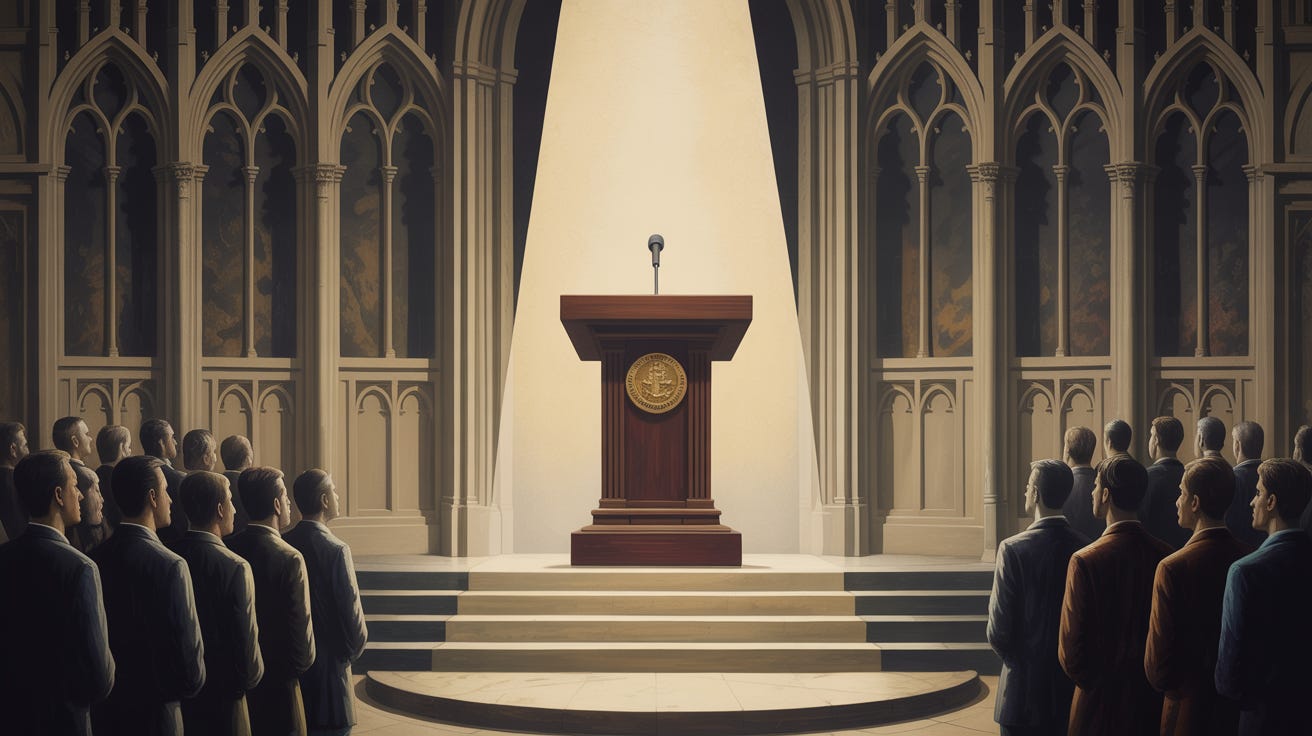
In light of the recent assassination of Charlie Kirk, it’s tempting to pin the proclivity for political violence on “the left,” since the shrillest liturgy of state-as-god invariably comes from that pew. But if you look at American politics with clear eyes, you’ll find that large numbers of people across the aisle have succumbed to the same disease.
The left wants a life of cradle-to-grave dependence in the loving arms of mommy government. The “free market” right melts down the moment you mention trimming Pentagon budgets. So for clarity’s sake, we’ll do away with arbitrary qualifiers like “left” and “right,” and call them what they are in essence: government worshipers.
Now, why is it a mistake to engage in good-faith debate with those who worship the state? Why can you expect them to answer mild, even compassionate attempts at dialogue with bike locks to the head, bomb threats and gunshots?
Why good-faith debate fails
As Aristotle noted in Rhetoric, most people do not come to hold core beliefs because they reasoned their way into them, and reason will likely not be what dissuades them from clinging to those beliefs:
“[Rhetoric] is essential because, in some cases, and with some audiences, even if we possessed the highest possible level of precise knowledge, it would still be difficult to persuade them by merely communicating the facts of the matter. This is because such scientific discourse belongs in the field of instruction and best serves the purpose of teaching, which is not always feasible.”
Modern research adds another uncomfortable truth to this observation: most people use their reasoning skills not to seek truth, but to justify and rationalize beliefs they already hold. Reason is often a social weapon, not a searchlight:
“Mercier and Sperber (M&S) argue that reasoning has evolved primarily as an adjunct to persuasive communication rather than as a basis for consequential choice. Recent research on decision-related regret suggests that regret aversion and concomitant needs for justification may underpin a complementary mechanism that can, if appropriately deployed, convert M&S’s facile arguer into an effective decision maker, with obvious evolutionary advantages.”
Once you understand this, it follows that the need to rationalize irrational beliefs is directly proportional to the incentives attached to maintaining them, and the disincentives tied to questioning them.
Skin in the game, mask on the face
Show me someone who worships government, and I’ll show you someone with skin in the game.
Government apologists are often masterfully adept at rationalizing the irrational and justifying the unjustifiable, sometimes reaching such clownish extremes that the rest of society looks on in bewilderment. But what drives this baffling behavior?
Incentives.
A paycheck signed by a government agency. A psychological void left by absent parental figures. A lack of spiritual fulfillment filled by the secular religion of state worship. Insecure mediocrity, desperately seeking validation from credential mills like academia or the military-industrial complex. Handouts through quotas, welfare, or preferential treatment by decree.
When you engage with a government worshiper, you are never truly discussing policy preferences, philosophy or economic theory. That might be the surface-level pantomime they would like you to engage in, but in reality, you are prying at a totem that gives them status, salary, meaning, and a tribe.
Disincentives to reason

So, there you are. Faced with someone whose beliefs are rationally, logically, mathematically, and objectively false. Impossible, even. Ridiculously so, in many cases.
Regardless, they have careers, loans, mortgages, marriages and social lives riding on those beliefs. Lives are built on them.
Consider the implications of that person even entertaining the possibility they might be, in fact, wrong. They would have to change jobs. Confront fundamental childhood trauma. Find higher meaning without being told what to value or believe. They would have to make something of themselves without the crutch of state-sanctioned credentialism, titles or favoritism.
An honest re-evaluation of their world view would require contemplating the moral implications of their life choices, and likely those of their loved ones as well. Worst of all, they would suffer backlash from their own tribe. No cult takes kindly to apostates.
That social pressure alone is sufficient to nudge them into a state of cognitive dissonance, embracing beliefs they rationally know to be ridiculous.
This habitual suppression of reason becomes an indispensable self-defense mechanism, a survival strategy that secures one’s position in the group.
They are their beliefs
Once you grasp the reality of these incentives and disincentives, it becomes clear that these people are fundamentally invested in not changing their minds.
Their beliefs are not up for debate or negotiation. They are a fundamental element of who they are, and without which, their self-image, their sanity, and their life in its entirety would collapse and crumble. They are unquestionable religious dogma. The alpha and the omega from which all of reality is derived. Because they have to be.
And once beliefs become identity, facts tend to bounce off like pebbles on plate armor:
Identity protective cognition refers to the tendency of culturally diverse individuals to selectively credit and dismiss evidence in patterns that reflect the beliefs that predominate in their group. On issues that provoke identity-protective cognition, the members of the public most adept at avoiding misconceptions of science are nevertheless the most culturally polarized. Individuals are also more likely to accept misinformation and resist the correction of it when that misinformation is identity-affirming rather than identity-threatening.
By bringing common sense argumentation, facts, numbers, objectivity to the table, however well-intentioned you may be, you are attacking the very core of their being. The better your arguments, the more dangerous you become. The more influence your ideas have, the wider the threat is perceived.
Reaching a whole nation, or, God forbid, the world, with opposing ideas, however commonsensical or moderate they may be, constitutes a nuclear-level threat to their ability to rationalize themselves into believing they are morally "good people."
To you, a debate might be an interesting intellectual exercise, the worst possible outcome of which would be that you learn something new. To them, it is an existential struggle for survival.
There is no common ground
For a relatively long time in contemporary history, most of our interactions with others were grounded in the assumption that there is at least some common ground to be found.
It was considered a given that there are fundamental values and goals that we can all agree on, and that the purpose of any societal debate is to compare ideas and flesh out how we go about pursuing these common values and goals. If you are not a government worshiper, some of the things you value might be: the survival of humanity, a prosperous society, the sanctity of life, and the importance of liberty.
In other words: it used to be a given that we all ultimately strive towards peace, prosperity, liberty, and human flourishing.
Sadly, as history shows, and as we are currently seeing again, it is a grave mistake to project such values and goals onto others.
As the masks come off, we come to learn that there is a large portion of society that, when confident enough, will proudly declare that it: desires the extinction of humanity, wants degrowth, not prosperity, rejoices in murder and violence, and prefers the rest of society chained and silenced.
What middle ground can you realistically hope to reach with someone who wants humanity to die?
What common ground is there to be found with those who campaign for a violent state machinery to confiscate your possessions?
What win-win compromise exists with someone who celebrates your death?
The record of the church of the state
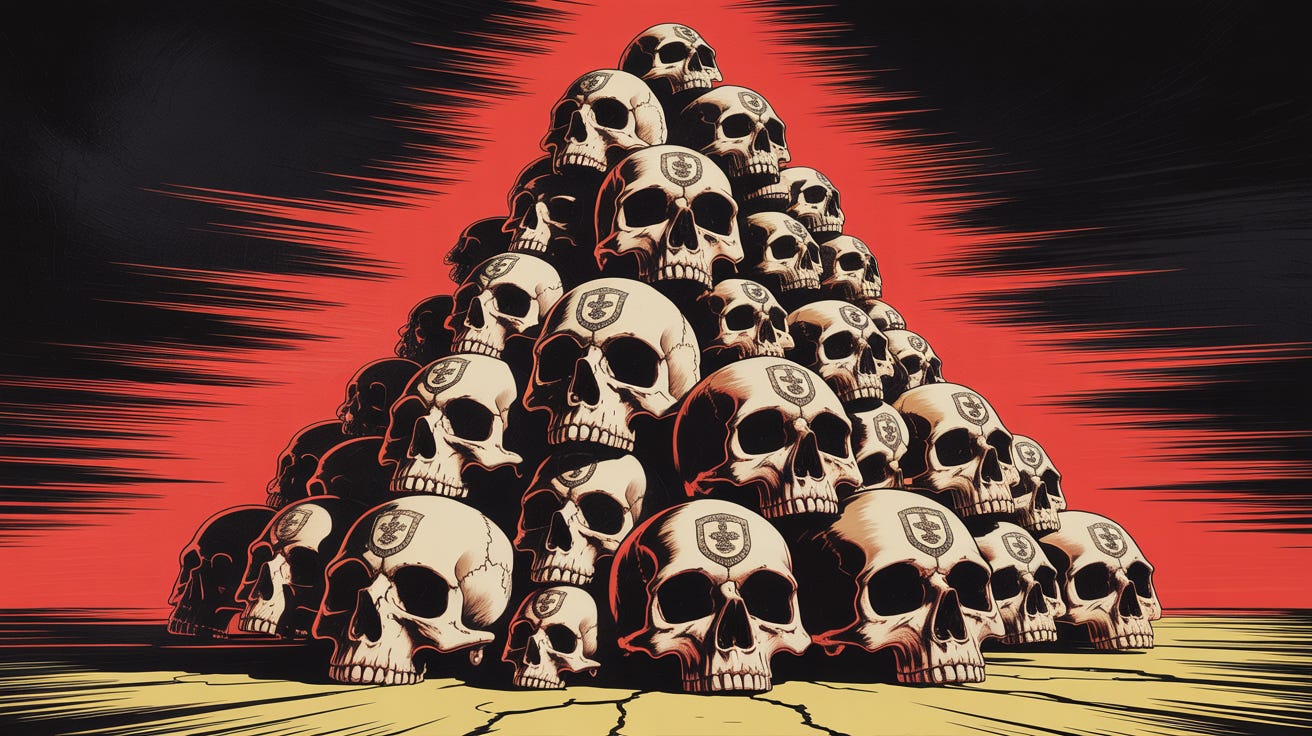
It would behoove non-statists to disabuse themselves of the notion that their opponents argue in favor of their violent, destructive, morally repugnant belief system because, deep down inside, they share our values of altruism, benevolence and compassion, and they “just don’t know any better” or “they have been misinformed.”
Here’s a question for you: how many decades, centuries should we give those who answer our arguments with violence to "learn better" or “inform themselves?” How many merciless dictatorships should we let run rampant over civilization in hopes that they will see the error of their ways? How many mass graves will it take for them to change their minds?
Because that is the historical reality of the ideology we are dealing with:
“Based on a lifetime of research on democide, Rummel calculates that—for the period of 1900-1999—a total of 262 million human beings were murdered by governments. This figure excludes deaths that occurred based on clashes between armies (direct military conflict).
The typical figure for First World War casualties is 9 million dead, and it is estimated that 56 million died during the Second World War. If we factor in other wars during the 20th century, perhaps a minimum of 325 million human beings were killed as a result of collective forms of violence generated by nation-states (we omit here discussion of the ‘wounded’).”
We have a century of ledger entries written in blood. An immense pile of dead bodies over which they will eagerly hop to shamelessly demand more of what rightfully belongs to others.
They do know better. They have been informed.
They just. Don’t. Care.
The hard truth about “good people” with evil beliefs
There is a common error among those of us who argue for less government, less force, less coercion, less violence in society. Because we engage with opposing ideas from a place of compassion, altruism and a genuine desire to drive society forwards toward a better life for everyone, we naively tend to project these motivations onto our ideological opposition.
But here is the hard truth that we, and polite society in general, refuse to face:
They are emotionally and materially invested in never changing their minds.
Good arguments threaten their standing, their self-image, and their social circle.
They do not share your ends. They value neither life, liberty nor prosperity.
Their ideology has a proven, industrial-scale body count. Is is the single largest cause of unnatural death in human history.
So no, they are not waiting for “a better explanation” of the same concepts they have rejected hundreds, maybe thousands of times before. No, they won’t change their minds if you explain Mises more clearly. They heard you.
And they don’t care.
What to do with this knowledge
Maybe, it’s time to consider some of the following, next time you feel the urge to reason with a knife-wielding angry mob.
Maybe, the people who want humanity extinct aren’t misled. Maybe, they just hate humanity.
What if those who argue for your possessions to be taken from you don’t genuinely believe it will “help the poor” or “provide free health care?” What if they just want your stuff, and they don’t particularly care what excuses or methods it takes?
Maybe, those who cheer political violence don’t do so because the ADL lied to them and they genuinely believe Hitler is back. Maybe, they aren’t just misguided poor souls who simply misunderstand your good intentions. Maybe, they just want you dead.
So stop offering yourself up for ritual sacrifice on the altar of “dialogue” with people who couldn’t care less about truth or reality.
Build parallel institutions. Make your family antifragile. Withdraw your attention and your money from their machinery. Protect what is yours. Defend the good, the true, and the beautiful where you actually have influence and authority.
Because the mask is off.
Explore more Popular Philosophy:
Start Philosophy | Definitive Guides | Topics | Today in Philosophy | Podcast
Popular Philosophy publishes definitive guides and essays centered around moral realism, objective truth, Stoicism, ancient philosophy, medieval philosophy, and deeper explorations of the true, the good and the beautiful. Expect carefully researched articles that dissect current event through timeless ideas, for readers who want clear reasoning, primary sources, intellectual honesty and serious philosophy, free from ideological trends and academic fashion.
Subscribe now to support our growing, independent philosophical knowledge base on the timeless questions that shape human life and civilization.