



Philosophy is disciplined rational inquiry into the most fundamental and general questions about reality, knowledge, reasoning, value, mind, language, and human life. It asks what things are, why they are so, what we can know about them, which conclusions follow from which premises, and how human beings ought to live.
That definition also explains why philosophy can move across so many subjects without becoming a miscellaneous collection of opinions. The topic may be mind, law, science, religion, language, or morality, but the philosophical task repeatedly turns toward the same kinds of demands: clarify what is being claimed, identify the principles at stake, ask what follows, and determine what reasons actually support the conclusion. Philosophy becomes most visible when a familiar subject is pressed to the point where its assumptions need an account of their own.
The Greek word philosophia carries the idea of a love or pursuit of wisdom. The ancient Greek lexicon records senses such as “love of knowledge,” pursuit, speculation, and study. Plato presents the philosopher as someone between wisdom and ignorance, seeking what he does not yet possess. Aristotle associates wisdom with knowledge of first principles and causes. Kant asks what reason can know, what it ought to do, and where its limits lie. Russell describes philosophy as a critical attempt to deal with ultimate questions that ordinary life often leaves unexamined.
There is therefore no single technique called “the philosophical method.” Philosophers have used dialogue, dialectic, demonstration, analysis, induction, skeptical criticism, transcendental critique, conceptual clarification, counterexamples, distinctions, and thought experiments. Wittgenstein went so far as to say that philosophy has methods rather than one method, comparing them to different therapies.
This article was last updated on August 26, 2026, at 9 PM CEST.
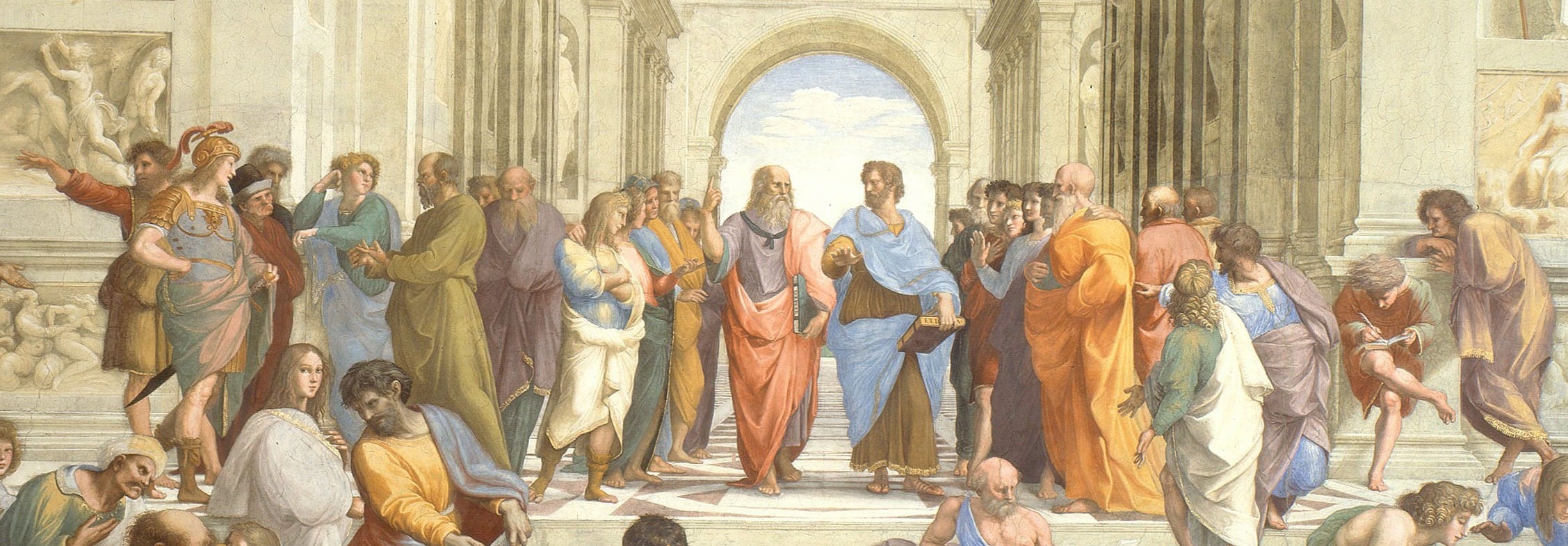

What is philosophy in brief?
Philosophy seeks wisdom through reasoned inquiry, especially about fundamental questions that cannot be settled merely by collecting more facts.
It begins by admitting that something needs to be understood. Socrates dramatizes this as awareness of ignorance. Aristotle traces philosophy to wonder.
Philosophers ask questions about reality, knowledge, argument, goodness, justice, mind, language, science, religion, law, beauty, and human existence.
Philosophers use several methods. Socratic examination, Aristotelian dialectic and demonstration, Cartesian analysis, Baconian induction, Humean criticism, Kantian critique, and Wittgensteinian clarification are historically important examples.
Philosophy can produce knowledge, although philosophers disagree about its extent and certainty. At the very least, philosophical reasoning can establish distinctions, expose contradictions and invalid inferences, clarify concepts, test assumptions, and sometimes support substantive conclusions about reality and value.
What does “philosophy” mean?
The familiar translation of philosophia as “love of wisdom” is useful, but it is only the beginning of a definition.
Wisdom is not simply possession of many facts. A person might know thousands of historical dates, chemical formulas, or legal provisions while remaining unable to answer basic questions about what knowledge is, what makes an explanation good, whether justice is objective, or what kind of life is worth living.
Philosophy turns toward those deeper questions.
Philosophy as the pursuit of wisdom
In Plato’s Symposium, Diotima tells Socrates that the wise do not seek wisdom because they already possess it, while the completely ignorant do not seek it because they do not recognize their deficiency. The lover of wisdom occupies the intermediate position. He knows enough to recognize that there is more to know. Plato thus builds the pursuit of philosophy into a condition of intellectual incompleteness.
This fits the Socrates of the Apology. Socrates discovers that many reputedly wise people know something within their trades or specialties, then mistakenly assume that their competence extends much further. His peculiar advantage is that he does not pretend to possess knowledge he lacks. His compact formulation is famous:
“I neither know nor think that I know.”
Philosophy on this account is neither omniscience nor intellectual paralysis. It is the deliberate movement from recognized ignorance toward better understanding.
Philosophy seeks causes and first principles
Aristotle gives the classical definition greater intellectual structure. The person with experience knows that something happens. The wiser person understands why. Wisdom therefore moves toward causes and principles.
In Metaphysics I, Aristotle describes wisdom as knowledge of principles and causes. The more universal and fundamental the explanation, the closer it comes to the kind of knowledge traditionally called wisdom. He later defines first philosophy as the inquiry into “being as being,” meaning reality considered at the most universal level rather than one restricted domain of reality.
This gives us a distinction that remains useful:
A specialized inquiry asks about one part or aspect of reality. Philosophy can ask about the assumptions, causes, categories, and principles that apply across such inquiries.
A physicist may study particular causes of physical events. A philosopher can ask what causation itself is. A neuroscientist may identify neural correlates of consciousness. A philosopher can ask what would make a mental state identical with, caused by, or irreducible to a brain state.
Natural reason and first causes
Jacques Maritain, working in the Aristotelian and Thomistic tradition, defines philosophy as knowledge that uses the natural light of reason to investigate first causes and highest principles. His distinction between philosophy and the specialized sciences depends less on which objects they investigate than on the standpoint from which they investigate them. Both can discuss the same world, but philosophy asks about more fundamental causes and principles.
That formulation also distinguishes philosophy from revealed theology. Philosophical premises must stand on rational grounds rather than deriving their authority from revelation.
Philosophy examines categories, not merely instances
R. G. Collingwood approached the problem differently. In An Essay on Philosophical Method, he argued that philosophical concepts cannot always be treated like classifications in the empirical sciences.
A geologist can distinguish kinds of rock by examining specimens. Philosophical concepts such as action, cause, mind, knowledge, duty, or history are more difficult. They partly structure how we understand and describe the phenomena in the first place.
Collingwood consequently treats philosophy as a distinctive kind of reflective and categorical thinking rather than an immature version of empirical science. His book devotes separate attention to the differences between philosophical concepts, empirical concepts, exact sciences, hypothetical reasoning, and categorical judgment.
Philosophy as a recurring intellectual experience
Étienne Gilson adds a historical dimension. His The Unity of Philosophical Experience treats major systems of philosophy as experiments in what philosophical knowledge can be. Logic, mathematics, physics, theology, psychology, and sociology have repeatedly been proposed as models that could absorb or replace philosophy. Gilson’s larger argument is that these attempts reveal something about philosophy precisely because their histories expose the limits of reducing philosophical questions to another discipline.
This is one reason the history of philosophy has unusual importance. Studying Plato or Kant is not analogous merely to studying obsolete episodes in the history of chemistry. Their arguments can still be arguments. A syllogism does not cease to be valid because it is two thousand years old, and a metaphysical objection is not answered simply by the passage of time.
Why philosophy begins with ignorance and wonder
Two of the oldest accounts of philosophy’s beginning remain among the best.
▪ Socratic ignorance
Socrates begins by discovering that he cannot adequately answer a question he thought he understood.
The opening of Plato’s Meno gives the pattern beautifully. Meno asks whether virtue is taught, acquired by practice, possessed by nature, or obtained in some other way. Socrates refuses to race immediately toward one of those answers. How could they decide how virtue is acquired before determining what virtue is?
Meno confidently produces examples of different virtues. Socrates asks what makes all of them instances of virtue. The discussion therefore moves from assumed familiarity to perplexity, then from perplexity to definition and argument.
Socratic ignorance should not be confused with the claim that nothing can be known. Socrates himself makes moral judgments in the Apology. His target is false confidence, especially the tendency to mistake competence in one domain for wisdom about everything else.
This is one of philosophy’s permanent intellectual disciplines: know the difference between what you have established and what you have merely assumed.
▪ Aristotle’s wonder
Aristotle identifies another beginning. Human beings encounter something that seems strange, puzzling, or unexplained. They wonder.
He writes that “owing to their wonder” people began to philosophize. At first they wondered about obvious puzzles. They then advanced to questions about the heavens and the origin of the universe. The person who wonders recognizes his ignorance, and the desire to remove that ignorance drives inquiry.
Wonder is therefore more than astonishment. It contains an implicit question: why is this so?
A child who asks why anything exists is already brushing against metaphysics. Someone who notices that every attempt to justify induction seems to rely on induction has encountered an epistemological problem. Someone who realizes that a perfectly legal action might nevertheless be unjust has discovered the difference between legal validity and moral rightness.
Philosophy begins when the familiar ceases to be intellectually invisible.
What questions do philosophers ask?
Philosophers often begin with ordinary words and discover extraordinary problems inside them.
What is knowledge? What is a cause? What makes the same person persist through time? What is justice? Do human beings have free will? Are moral judgments true or merely expressive? What makes an argument valid? Does consciousness reduce to matter? What does a word mean? What makes a law legitimate? Can God’s existence be known by reason?
Plato repeatedly asks “What is it?” questions. What is virtue? What is justice? What is knowledge? What is courage? His dialogues demonstrate that being able to recognize examples is not always the same as understanding what all the examples have in common.
Aristotle widens that range further. What is being? What are the causes of things? What makes demonstration possible? What is the human good? What is virtue? What distinguishes persuasion from proof?
Russell opens The Problems of Philosophy with an apparently simple challenge: can anything be known with such certainty that no reasonable doubt remains? From there, a familiar table in an ordinary room becomes an entry point into appearance, reality, perception, matter, induction, universals, truth, and the limits of knowledge.
Kant offered perhaps the neatest map. In the Critique of Pure Reason he famously organizes the interests of reason around three questions. His later Logic adds a fourth:
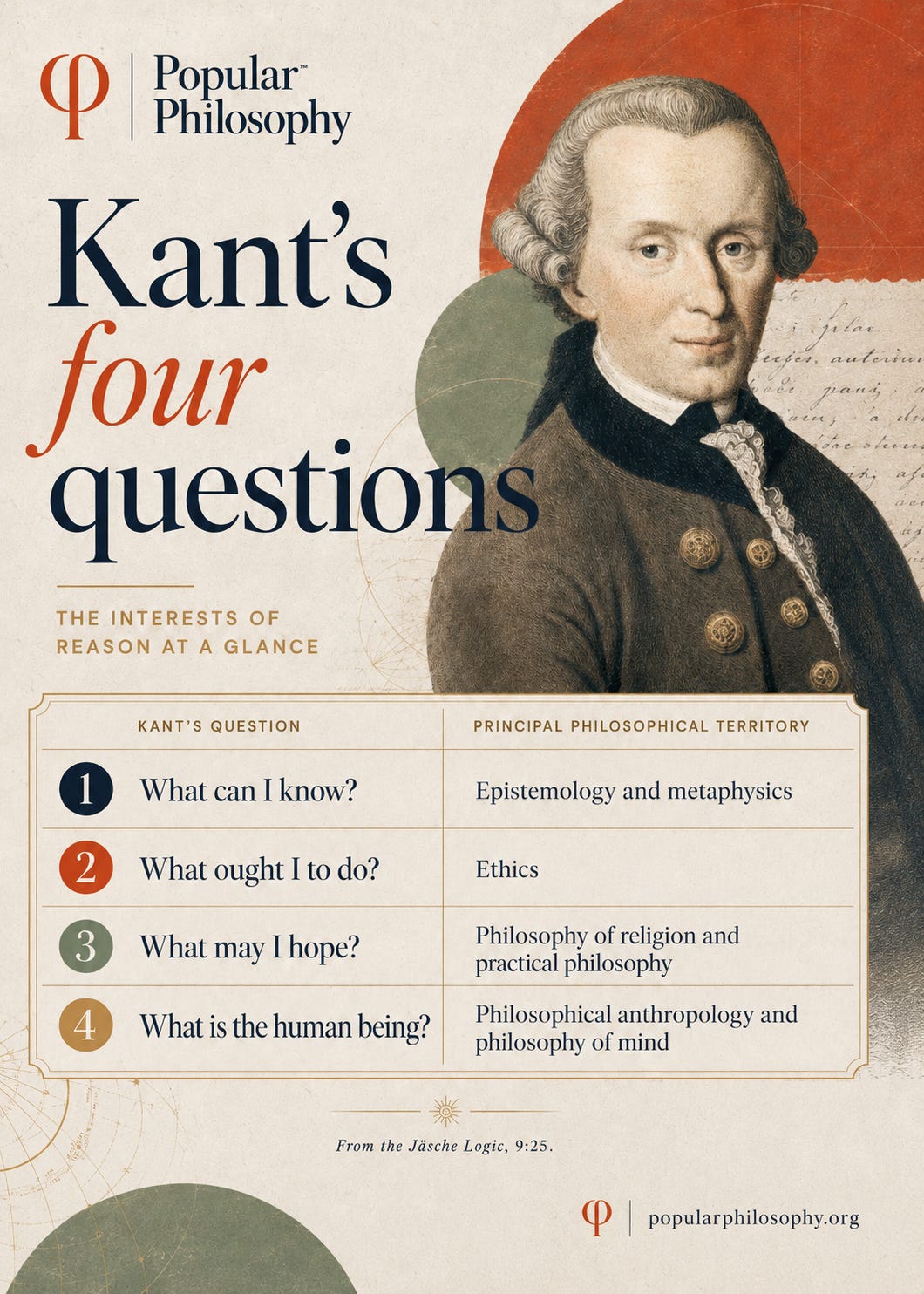
Kant offers a compact way to map philosophy through four fundamental questions. “What can I know?” leads into epistemology and metaphysics because it concerns the scope, grounds, and limits of human knowledge. “What ought I to do?” belongs principally to ethics, where philosophers examine duty, right action, virtue, and the standards by which conduct should be judged.
His third question, “What may I hope?”, opens into philosophy of religion and practical philosophy, since it concerns the relationship between human action, ultimate ends, and what reason permits us to expect. The fourth, “What is the human being?”, belongs to philosophical anthropology and philosophy of mind.
Kant ultimately treats the first three questions as relating back to this final one because questions about knowledge, action, and hope all depend in some way on what kind of beings we are. The familiar four-question formulation is found in the Jäsche Logic, 9:25.
The variety may be enormous, but philosophical questions tend to turn toward foundations, meanings, conditions, reasons, categories, norms, or implications.
What makes a question philosophical?
There is no mechanical test. Philosophy has repeatedly changed its boundaries, and many questions sit partly inside philosophy and partly inside another discipline.
A useful diagnostic is to ask whether answering the question requires us to examine concepts, first principles, standards of evidence, logical relations, normative judgments, or the presuppositions of another inquiry.
Compare the following:
A neuroscientist might ask which brain regions become active when a person reports pain. The philosophical question behind that investigation is different: what is pain, and is a conscious experience identical with a brain state?
Physics may ask how objects accelerate under certain conditions. Philosophy can then ask what a law of nature is and what kind of thing causation is.
Law can ask which statute governs a particular dispute, while philosophy of law asks what makes a rule legally authoritative and whether an unjust law can still bind morally.
Linguistic research might investigate how people actually use the word “knowledge.” Philosophy asks what knowledge is and what distinguishes it from a merely lucky true belief.
Political science can measure which policies voters prefer, while political philosophy asks what makes political authority legitimate.
Psychology or social science can investigate which behaviors increase reported happiness. Ethics asks what happiness itself is and whether subjective satisfaction is the same as human flourishing.
Cosmology may investigate what happened before the Big Bang model’s earliest describable state, while metaphysics can ask why anything exists at all and whether every contingent reality requires an explanation.
The border can move. A question may begin philosophically and later become experimentally tractable. Russell observed that subjects often cease to be called philosophy once a stable body of specialized knowledge emerges from them. Psychology, physics, astronomy, linguistics, and economics all have historical relationships with philosophical inquiry.
Yet specialization does not necessarily eliminate the philosophical problem. Discovering the neural mechanisms associated with reasoning does not by itself determine what makes an inference valid. Measuring preferences does not determine what anyone ought to prefer. Cataloging scientific practices does not alone settle what makes a theory explanatory or what evidence warrants belief.
Collingwood presses this distinction strongly. Some philosophical questions concern categories through which an empirical discipline understands its own subject. Wittgenstein arrives at a different but related insight: some problems cannot be solved by adding new observations because the trouble lies in how our concepts and language are operating.
How philosophers reason
Philosophy has methods, but no universal procedure guarantees philosophical truth.
The best method depends on the question. Aristotle does not investigate demonstrative knowledge in exactly the way Hume investigates causation. Kant’s critique of reason is unlike Bacon’s program for investigating nature. Wittgenstein explicitly rejects the idea that philosophy must operate through one fixed method.
Still, several enduring approaches give a beginner a remarkably good picture of philosophical practice.
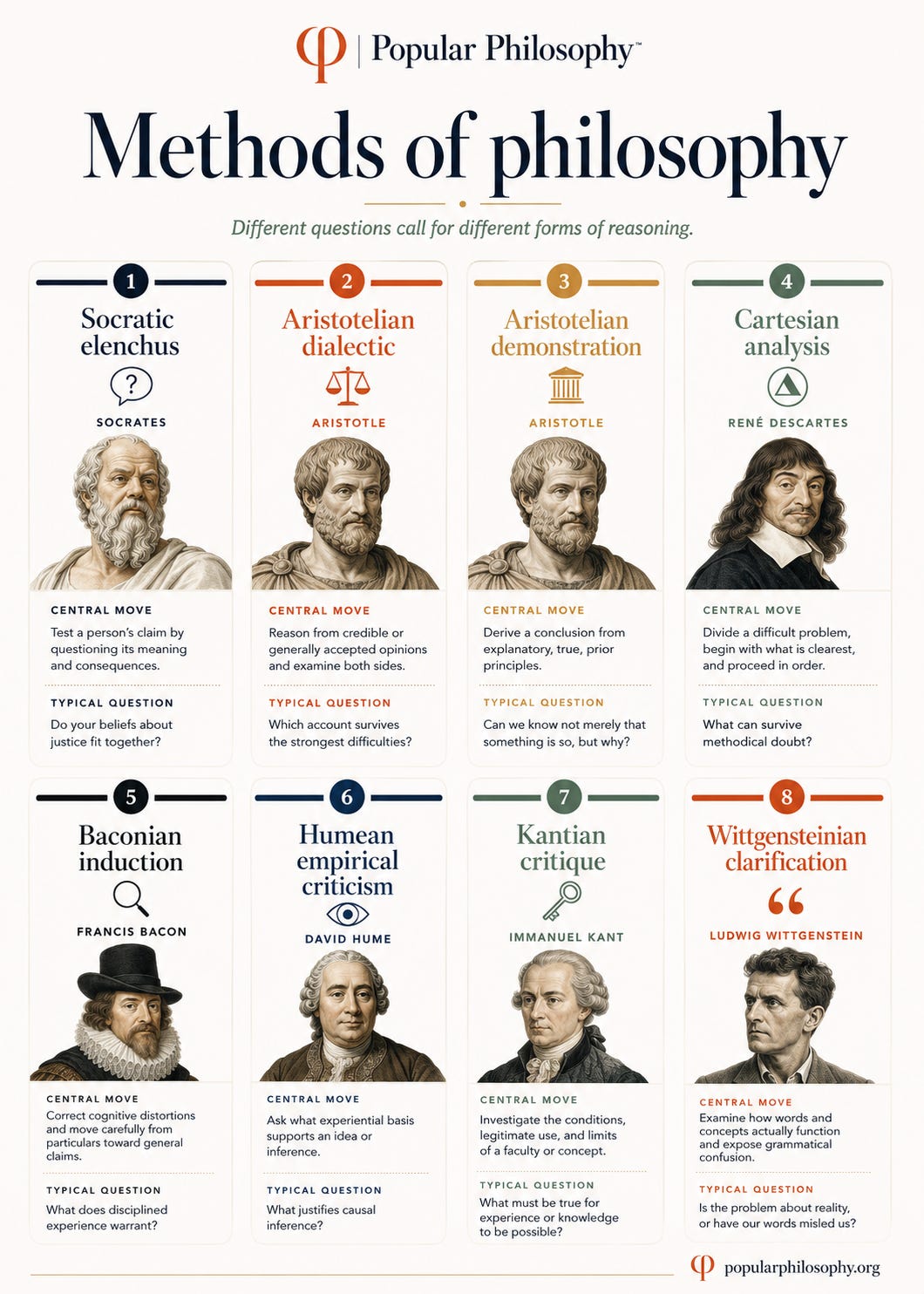
The Socratic elenchus: examine what you think you know
The Socratic elenchus begins by testing a person’s claim through questions about its meaning and consequences.
The Greek word elenchus refers to examination or refutation. Socrates’ conversations commonly begin when someone offers a confident claim or definition. Socrates asks questions, secures further commitments, and then examines whether those commitments fit together. The characteristic challenge is whether someone’s beliefs, perhaps about justice, remain coherent once their implications are made explicit. When a contradiction or counterexample appears, the original claim must be reconsidered.
The purpose of this philosophical method at its best is not victory. It is intellectual correction.
In the Apology, Socrates describes examining people who appeared wise and discovering a recurrent defect: they believed themselves knowledgeable beyond what they could actually defend. He presents philosophical examination as a continuing interrogation of oneself and others.
A simplified Socratic pattern looks like this: define the thing under discussion, state what you believe about it, follow those commitments to their consequences, discover any contradiction or counterexample, and revise.
Modern philosophy still works like this constantly whenever an argument is tested for internal consistency rather than accepted because its conclusion initially sounds plausible.
Aristotelian dialectic: reason through serious disagreement
Aristotelian dialectic reasons from credible or generally accepted opinions while examining the strongest difficulties on opposing sides.
Aristotle’s Topics begins by distinguishing kinds of reasoning and explains that dialectical reasoning starts from endoxa, opinions that are generally accepted or accepted by reputable thinkers. This does not mean that majority opinion becomes truth. The point is methodological. When first principles themselves are under examination, the philosopher cannot simply assume the disputed conclusion and proceed as though the controversy had already been settled.
Dialectic instead begins from serious candidate beliefs, examines their consequences, raises difficulties on both sides, and asks which positions survive. Aristotle explicitly says this ability helps us detect truth and error and provides a route toward the principles of inquiries.
This ancient method remains recognizable whenever philosophers ask questions such as: What would follow if determinism were true? What must the moral relativist say about intolerant cultures? Can a materialist account for intentionality? Can the realist explain persistent disagreement?
Its discipline lies in confronting the strongest difficulties rather than avoiding them. Good dialectic makes an argument stronger before trying to defeat it.
Aristotelian demonstration: explanation, not merely inference
Aristotelian demonstration aims at a stronger kind of knowledge than dialectical investigation. Dialectic helps philosophers reason through disputed starting points, while demonstration asks whether a conclusion can be derived from explanatory, true, and prior principles. Its central concern is whether we can know not merely that something is the case, but why it must be so.
In the Posterior Analytics, Aristotle says that scientific knowledge involves knowing the cause on which a fact depends. A demonstration is therefore more than a formally valid syllogism. Its premises must have the right explanatory relationship to the conclusion, and Aristotle describes them as true, primary, immediate, prior, and better known in the relevant sense.
That insight remains invaluable because several different successes and failures in reasoning can otherwise be confused. You can have a valid argument from false premises. You can have a true conclusion supported by a bad argument. You can also correctly predict that something will occur while misunderstanding why it occurs.
Philosophical rigor therefore requires separate questions: Is the conclusion true? Does it follow from the premises? Are the premises true? Do those premises actually explain the conclusion?
Aristotelian demonstration treats explanation as a part of knowledge rather than an optional addition to a correctly inferred result.
Cartesian analysis: divide the problem and rebuild from what survives doubt
Cartesian analysis is a method for bringing order to difficult problems by breaking them into smaller parts, beginning with what can be established most clearly, and then proceeding carefully toward more complex conclusions.
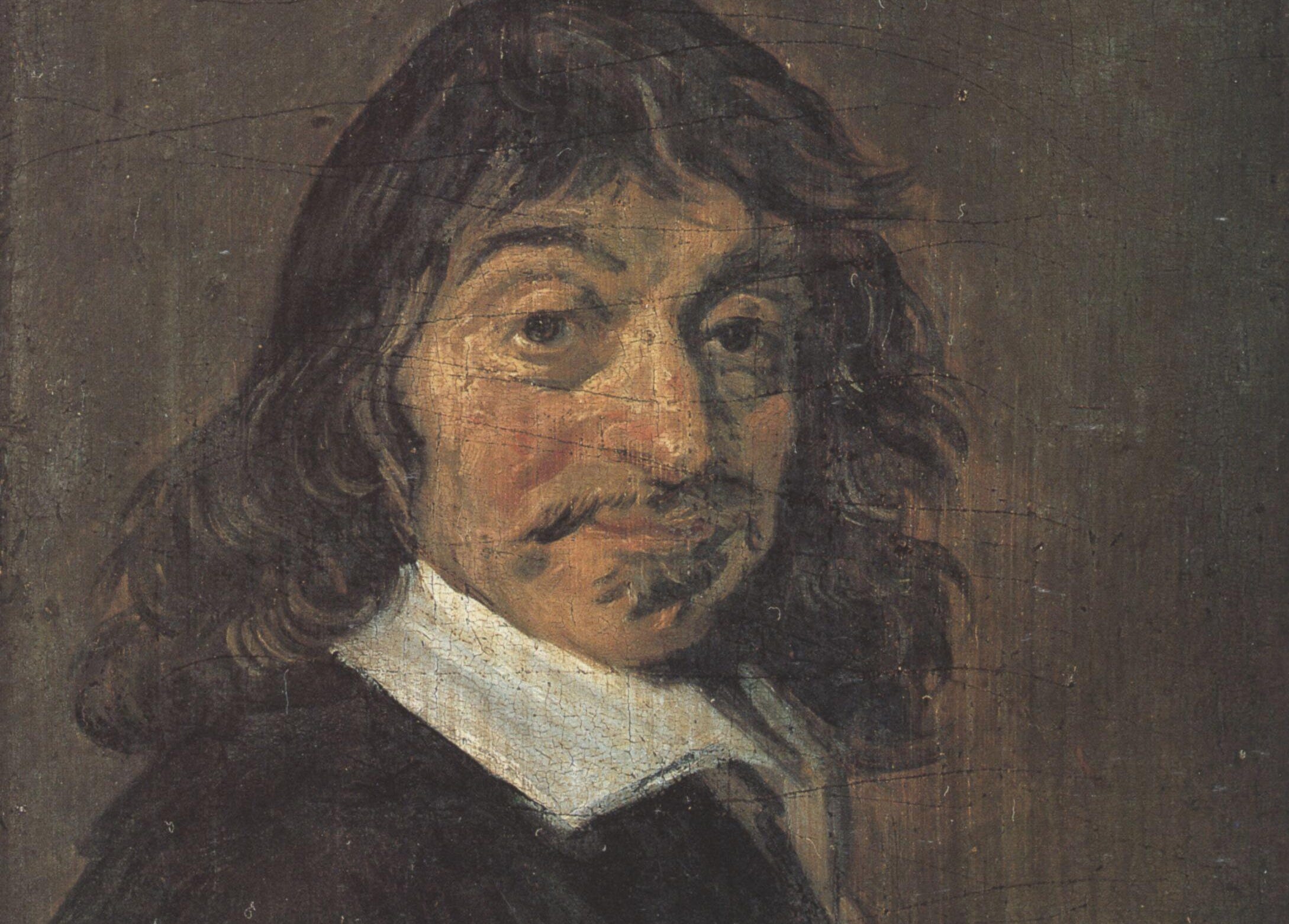

In Part II of the Discourse on Method, Descartes proposes four rules for conducting inquiry:
accept nothing as true without adequate clarity
divide difficult problems into parts
move from simpler matters toward more complex ones
review the reasoning thoroughly enough to avoid omissions
The point is to prevent a complicated question from hiding assumptions or uncertain steps inside an apparently convincing conclusion.
Methodical doubt serves a specific role within this larger project. Descartes deliberately subjects his beliefs to skeptical pressure and asks which of them could still function as secure foundations for knowledge. He does not advocate permanent uncertainty or claim that nothing can be known. Doubt is a test.
If a proposed starting point can be seriously doubted, Descartes does not want to build further conclusions upon it. He instead searches for something that remains certain even when skeptical challenges are pushed as far as possible, and then attempts to reconstruct knowledge from that foundation.
This approach profoundly influenced modern epistemology because it changes where philosophical inquiry begins. Instead of taking the external world and ordinary beliefs as unquestioned starting points, Descartes first asks what can be justifiably treated as certain.
Analysis breaks the problem apart, doubt tests the foundations, and reconstruction asks what knowledge can legitimately be built from whatever survives.
Baconian induction: discipline experience before generalizing from it
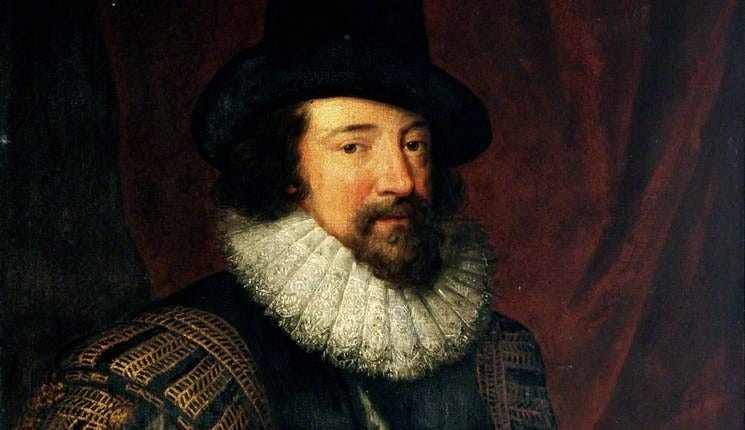
Baconian induction attempts to correct cognitive distortions and move cautiously from particular observations toward more general claims.
.jpg)
Francis Bacon distrusted reasoning that begins with inherited systems and then forces nature to fit them. In the Novum Organum, he identifies four families of “idols,” systematic sources of intellectual distortion.
The Idols of the Tribe arise from features of human nature.
The Cave reflects individual dispositions and education.
The Market concerns distortions produced through language.
The Theatre consists of received systems and dogmas that stage artificial intellectual worlds.
Bacon’s proposed cure is disciplined induction. This is often simplified into “observe many things and generalize,” but his ambition is more demanding. Inquiry should control for prejudice, compare cases, seek negative instances, vary conditions, and resist jumping prematurely to grand axioms. Its concern is what disciplined experience genuinely warrants once prejudice and premature generalization have been controlled. The method therefore treats the reliability of the investigator as part of the problem of inquiry.
Bacon’s lesson reaches beyond experimental science because the mind can corrupt the evidence before it knows that it has done so. A method for learning from particulars must consequently examine the habits and assumptions through which those particulars are interpreted before it moves confidently toward general conclusions.
Humean empirical criticism: ask what experience actually warrants
Humean empirical criticism asks what experiential basis supports an idea or inference.
David Hume applies this question especially forcefully to causal reasoning, where human beings constantly move from observed events to expectations about unobserved ones. Fire has burned before, so we expect it to burn again. Bread nourished us yesterday, so we expect similar bread to nourish us tomorrow. The apparently simple transition conceals a philosophical problem: what justifies moving from the regularities we have experienced to claims about cases we have not yet experienced?
Hume argues that causal conclusions cannot be established simply by inspecting the concept of a cause. Experience teaches repeated conjunctions, yet attempts to justify the general reliability of past-to-future inference appear to rely upon the very kind of inference they are supposed to justify. Habit or custom can explain psychologically why we expect one event after another, but this creates the famous philosophical problem of induction rather than providing a deductive solution to it.
Hume does not respond by refusing to live or by embracing total practical skepticism. His mitigated skepticism aims at intellectual modesty, careful attention to evidence, and respect for the proper limits of reasoning.
The force of Hume’s method lies in a deceptively simple challenge: what entitles you to make that inference?
Kantian critique: investigate the conditions and limits of reason
Kantian critique investigates the conditions, legitimate use, and limits of a faculty or concept.
Kant accepts that human beings possess knowledge and then asks how such knowledge is possible. His “critical” philosophy does not use criticism in the ordinary, commonly used sense of the word. It puts reason itself under examination by asking about its powers, conditions, legitimate uses, and boundaries. The characteristic Kantian question is therefore: What must already be true for this kind of experience, judgment, or knowledge to be possible?
In the Critique of Pure Reason, Kant seeks to determine the powers and limits of pure reason and describes critique as a way of purifying reason and protecting it from error before the construction of a full metaphysical system. Rather than beginning only with objects, he examines the contribution made by the knowing subject and the structures through which objects can be experienced.
Critique therefore asks both what makes knowledge possible and how far the relevant faculty can legitimately go. It can reveal conditions that must already obtain for experience or judgment while also identifying points beyond which reason exceeds its proper use.
Whether Kant’s answers succeed is another question. His methodological innovation remains enormous because it turns the capacities and limitations of reason itself into an object of philosophical investigation.
Wittgensteinian clarification: clarify the concepts before inventing a theory
Wittgensteinian clarification examines how words and concepts actually function in practice.
The later Ludwig Wittgenstein often suspects that philosophers are trying to explain something that first needs to be described clearly. Instead of assuming that every philosophical problem requires a theory, his method asks whether the apparent problem may arise from the way language has misled us.
In Philosophical Investigations §109, he argues that many philosophical problems are not empirical problems awaiting another experiment. They arise from misunderstandings in the workings of language, so theoretical explanation can sometimes give way to careful description of linguistic practice.
His famous formulation in §43 says that for a large class of cases the meaning of a word is its use in language. Wittgenstein is not claiming that every question about meaning can be answered simply by watching how people use a word. His point is that philosophers often assume that a meaningful word must correspond to some single object, property, or hidden essence that explains all of its uses.
Wittgenstein asks us to test that assumption by looking at actual language. A word may function differently in different situations while those uses remain connected by overlapping similarities, rules, and practices. Philosophical mistakes occur when we ignore that variety and invent a problem because we expect language to have a simpler structure than it actually does.
This is why in §116 Wittgenstein recommends bringing words back from metaphysical employment to ordinary use, while §133 denies that philosophy has one method and instead speaks of methods comparable to different therapies. Clarification is “therapeutic” because the philosopher may need to escape a conceptual picture rather than discover a new fact. His image in §309 captures his ambition: philosophy should “show the fly the way out of the fly-bottle”.
This does not mean that every philosophical problem is merely verbal or disappears once we consult ordinary usage. It means that before constructing a theory about mind, knowledge, meaning, or some other difficult subject, we should first ask whether the concepts in the question are being used coherently and whether the apparent mystery survives once their actual functions are made clear.
A practical philosophical workflow for beginners
The great methods above differ, but a beginner can combine several of their strongest habits without pretending to have discovered a universal algorithm. To see how the process works, consider a simple question: Is it always wrong to break a promise?
Most people already have intuitions about this question, which makes it useful for demonstrating how philosophy turns an everyday judgment into a more careful argument.
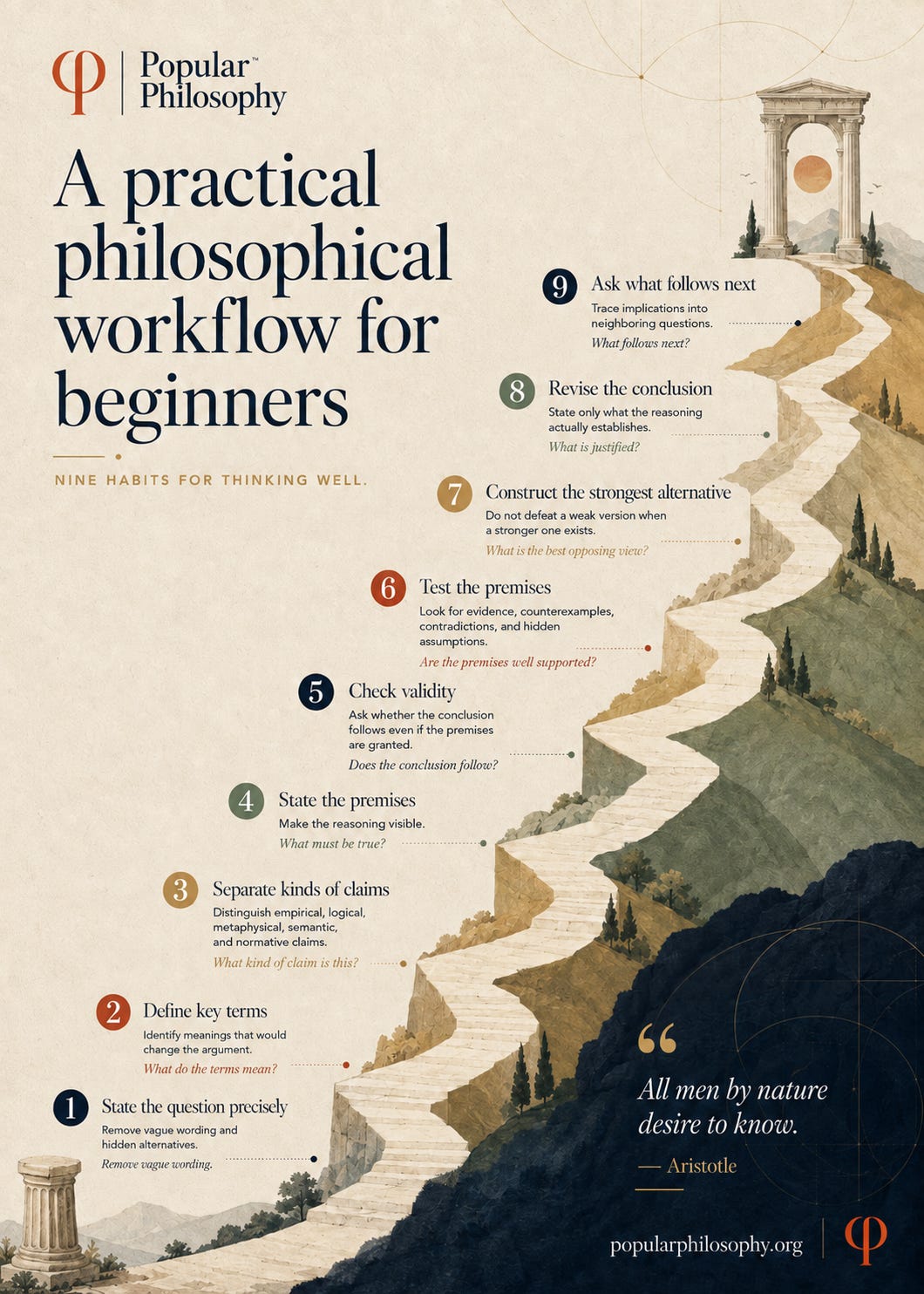
1. State the question precisely
A beginner can begin by stating the question precisely, removing vague wording and hidden alternatives.
“Is breaking a promise bad?” could mean that breaking promises is usually harmful, that people should generally keep their promises, or that breaking a promise is morally wrong under every possible circumstance. Those are different claims.
For our example, we can make the question more precise: Is it morally wrong to break a promise in every circumstance? The word “every” matters because a single justified exception would be enough to show that the strongest version of the claim is false.
2. Define key terms
The next step is to define the key terms whose meanings could change the argument. In our example, we need to know what counts as a promise, what it means for an action to be wrong, and perhaps what qualifies as breaking a promise.
Suppose you tell a friend, “I’ll meet you at the café at six.” Is that automatically a promise, or merely a statement of intention? Does “wrong” mean that an action should never be performed, or can an action be wrong in one respect while still being justified overall?
Clarifying these terms prevents people from appearing to disagree when they are actually using the same words differently.
3. Separate kinds of claims
Philosophical problems often contain several kinds of claims that need to be kept apart. It is then useful to separate different kinds of claims.
“People become angry when promises are broken” is an empirical claim that we could investigate by observing people. “Breaking promises makes other people less likely to trust us” is also largely empirical. But “therefore breaking a promise is morally wrong” is a normative conclusion about what someone ought to do.
Facts about anger, trust, or social behavior may be relevant to that conclusion, but they do not automatically establish it. Identifying the kind of claim being made helps us see where factual evidence ends and where philosophical reasoning still has work to do.
4. State the premises
The philosopher should then state the premises explicitly so that the reasoning becomes visible. Once the question and terms are clear, state the reasoning rather than leaving it implicit.
Someone might argue: Promises create obligations. Breaking an obligation is wrong. Therefore breaking a promise is wrong.
Making the premises visible lets us ask whether the conclusion actually follows from them. If both premises are accepted without qualification, the conclusion appears to follow. But the argument now exposes a deeper question that was hidden in the original intuition: is it really true that fulfilling an obligation is required in every circumstance?
Philosophy becomes easier to evaluate when the steps connecting a belief to its conclusion can be inspected separately.
5. Check validity
Once the premises are clear, the next question is whether the conclusion actually follows from them. Even if every premise were granted, does disagreement logically imply subjectivity?
If it is true that all promises create obligations, and if breaking any obligation is always wrong, then the conclusion that breaking a promise is always wrong follows. Someone could still reject the argument, but the problem would have to lie with one of its premises rather than with the logical connection between them.
This distinction is important. Showing that you dislike a conclusion does not show that an argument is invalid. Checking validity asks the narrower question: if these premises were true, would this conclusion follow?
6. Test the premises
A logically valid argument can still fail because one or more of its premises are false, exaggerated, or in need of qualification. The next step is therefore to test them with evidence, objections, and counterexamples.
Imagine that you promised to meet a friend for dinner, but on the way you encounter someone who has been seriously injured and needs immediate help. Keeping your promise would require leaving that person unaided.
This example does not prove that promises are unimportant. It tests the stronger premise that an obligation created by a promise can never be overridden by another consideration. If helping the injured person seems justified, we have discovered that “breaking an obligation is always wrong” may be too broad. We can now ask whether preventing serious harm sometimes outweighs the obligation created by a promise.
Counterexamples are useful because they reveal qualifications that an apparently obvious rule may need.
7. Construct the strongest alternative
Good philosophical reasoning does not stop after finding a problem with one argument. It asks what the strongest alternative explanation might be.
Someone defending strict promise-keeping might respond that the emergency example does not show that promises lose their force. Instead, it shows that we can sometimes have conflicting obligations. You still owe your friend an explanation and perhaps an apology, even though helping the injured person was the right thing to do.
Another view might say that promises normally create strong reasons for action but never absolute ones. A promise should be kept unless another sufficiently important moral reason outweighs it.
Constructing the strongest alternative prevents us from winning too easily against an oversimplified position. The goal is to understand the best version of each view before deciding which one explains the case more successfully.
8. Revise the conclusion
Philosophical reasoning should end with a conclusion no stronger than the argument actually supports. Discovering one justified exception to promise-keeping does not establish that promises do not matter or that people may break them whenever doing so is convenient.
Instead, we might revise the original conclusion from “It is always morally wrong to break a promise” to something more defensible: “Promises normally create moral obligations, but those obligations can sometimes be overridden by stronger considerations.”
A revised conclusion does not mean the inquiry failed. The original claim has become more precise as a result of it, because the argument revealed where it was too broad.
9. Ask what follows next
A philosophical answer often generates another question. Once we conclude that promises can sometimes be overridden, we need to ask when that is justified and how competing obligations should be weighed.
Does avoiding minor inconvenience justify breaking a promise? Probably not simply because we have established that emergencies can. How serious must the competing reason be? Does it matter how important the promise was, how much another person relied on it, or whether you could have prevented the conflict?
The original question has now opened into a deeper investigation about obligations, exceptions, competing duties, and moral judgment. That is a common pattern in philosophy. A good argument does not necessarily close a subject. It shows more clearly what has been established, what remains uncertain, and which question should be asked next.
The value of this workflow lies in making revision normal rather than humiliating. A philosopher can discover that a premise was too broad, that two meanings were being treated as one, or that an objection defeats only a particular argument rather than an entire position. Those are gains in clarity.
The aim is to end with a conclusion proportioned to the reasons actually established. That discipline connects the beginner’s workflow to the older methods described above, even though those traditions disagree about what philosophy ultimately can know.
The 11 main branches of philosophy
There is no authoritative list listing the exactly delineated branches of philosophy. Different universities, historical periods, and philosophical traditions divide the field differently.
Aristotle distinguished theoretical, practical, and productive forms of knowledge, with further divisions inside them. Kant organized philosophy around fundamental questions of knowledge, morality, hope, and humanity. Maritain distinguishes logic, theoretical philosophy, and practical philosophy, then subdivides them. Russell’s introductory work concentrates mainly on epistemology and metaphysics while observing that the boundaries between philosophy and the special sciences can change.
For a modern beginner, the following eleven-field map is especially useful:
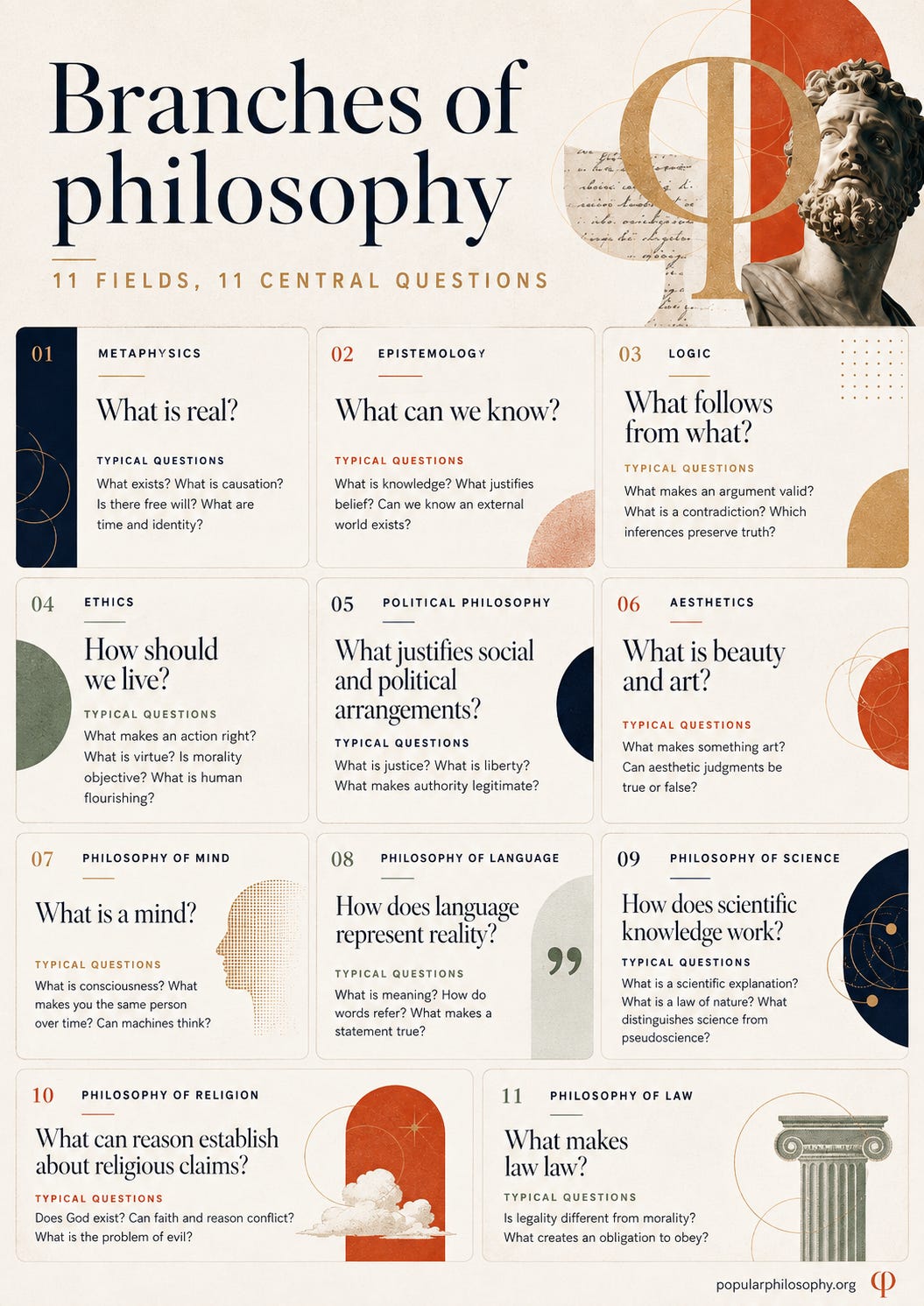
Metaphysics studies reality at its most general level. It asks what exists and investigates concepts such as causation, substance, identity, possibility, necessity, time, and free will.
Epistemology studies knowledge and justified belief. Its questions include what knowledge is, what human beings can know, what counts as evidence, and whether skepticism can be overcome.
Logic studies correct inference and argument. It asks what makes an argument valid, what follows from what, and how contradiction and consistency should be understood.
Ethics investigates goodness, right action, virtue, and flourishing. It asks what we ought to do, what makes an action right or wrong, and what kind of life is genuinely good.
Political philosophy studies justice, authority, rights, liberty, and political order. Its central questions include what legitimizes political power, what justice requires, and what rights persons possess.
Aesthetics examines beauty, art, taste, and aesthetic value. It asks what art is, whether beauty can be objective, and what makes a work aesthetically good.
Philosophy of mind investigates consciousness, thought, perception, agency, and personal identity. It asks what consciousness is, what a mind is, and whether thought can be reduced to brain activity.
Philosophy of language studies meaning, reference, communication, and linguistic structure. Its questions include what gives words meaning, how names refer, and whether language can mislead thought.
Philosophy of religion examines God, faith, reason, religious knowledge, and divine attributes. It asks whether God’s existence can be demonstrated and whether faith and reason are compatible.
Philosophy of science studies scientific knowledge, method, explanation, causation, and theory. It asks what distinguishes science, what confirms a theory, and whether the entities described by successful scientific theories should be regarded as real.
Philosophy of law investigates the nature, authority, interpretation, and morality of law. It asks what law is, whether legal validity can be independent of morality, and what creates political obligation.
Other fields include philosophy of mathematics, history, economics, education, technology, biology, medicine, history, and artificial intelligence. These are better understood as further applications and specializations than as evidence that the eleven-part map is wrong.
Metaphysics: what is ultimately real?
Metaphysics asks about reality at its most general level.
It covers questions about being, substance, essence, causation, identity, change, possibility, necessity, time, space, mind, free will, and the ultimate structure of reality.
Being as being
Aristotle’s formulation is foundational. Metaphysics IV announces a science that investigates “being as being.” Particular sciences isolate a portion of reality. Geometry studies mathematical objects. Natural philosophy studies changeable natural beings. First philosophy asks what can be said of beings insofar as they are beings.
This is also where Aristotle’s four causes become important. A full explanation may concern what something is made from, what form or essence it has, what produced the change, and what end or purpose it serves.
Metaphysics therefore asks questions that remain hidden if explanation is reduced to mechanism alone.
Substance, mind, and the foundation of reality
Descartes reorganizes metaphysics around the search for certainty.
Methodic doubt brings him first to the thinking self. From there he develops a metaphysics of thinking substance and extended substance, mind and matter, together with arguments concerning God and the external world.
The resulting dualism created problems that philosophy of mind still discusses. If mind and matter have radically different attributes, how do they interact? If the mind is known in a different manner from the body, what does that tell us about what either one is?
Descartes thus demonstrates how epistemology and metaphysics can become intertwined. A question about what we can know becomes a theory about what exists.
Can metaphysics become knowledge?
Kant does not simply continue earlier metaphysics. He investigates whether traditional metaphysical claims are legitimately knowable at all.
His distinction between phenomena, things as they appear under the conditions of human experience, and things considered independently of those conditions places limits on speculative metaphysics. Human reason naturally asks about God, freedom, the soul, the world as a totality, and the unconditioned. Kant argues that reason can overextend itself when it treats ideas exceeding possible experience as ordinary objects of theoretical knowledge.
The resulting dispute remains alive: does Kant rescue metaphysics by clarifying its limits, or concede too much to skepticism about reality beyond experience?
For a deeper application of metaphysical reasoning, see Popular Philosophy’s discussion of the quiet return of metaphysics inside ostensibly anti-metaphysical thinking.
Epistemology: what can we know?
Epistemology is the philosophy of knowledge.
Its central questions concern knowledge, belief, truth, justification, evidence, perception, memory, testimony, inference, skepticism, certainty, and intellectual error.
Knowledge requires more than confidence
Plato repeatedly distinguishes possessing an opinion from being able to give an account of it.
The Meno asks how inquiry is possible when we do not yet know what we are seeking. It also distinguishes knowledge from mere correct opinion. The Theaetetus later subjects proposed definitions of knowledge to sustained examination.
The Socratic lesson remains elementary and severe: feeling certain is not the same as knowing.
Knowing the cause
Aristotle’s Posterior Analytics offers one of the earliest systematic theories of scientific knowledge.
Full explanatory knowledge requires more than observing a regularity. We know scientifically, in the strongest Aristotelian sense, when we grasp why the conclusion must hold through its cause. He also recognizes that demonstration cannot continue backward indefinitely. First principles require a mode of apprehension that is not itself another demonstration.
This creates a permanent epistemological problem: how are ultimate premises known?
Survey the powers of the understanding
John Locke makes the human understanding itself the object of investigation.
His Essay Concerning Human Understanding asks about the origin, extent, and certainty of human knowledge. Rather than simply launching into metaphysical speculation, Locke asks what materials the mind possesses and what the understanding can legitimately do with them.
His project is partly anti-skeptical. We do not need infinite understanding in order to possess useful and genuine knowledge. Knowing the reach of our intellectual “line” can prevent both dogmatic overconfidence and paralyzing skepticism.
Locke’s work also leads naturally into philosophy of language because he concludes that a theory of knowledge cannot ignore words, general terms, and the relation between language and ideas.
Experience and the problem of induction
Hume radicalizes the empirical challenge.
If our knowledge of causal relations comes from experience, what justifies projecting observed regularities into unobserved cases? Appealing to the past reliability of induction appears to use induction in its own defense.
The problem reaches far beyond eighteenth-century philosophy. Every prediction, experimental generalization, and ordinary expectation about an unobserved future raises some version of it.
Conditions of possible experience
Kant responds to empiricism by arguing that experience itself depends upon forms and concepts supplied by the knowing subject.
The resulting “transcendental” question asks what conditions must obtain for coherent experience and objective knowledge to be possible.
Kant therefore does not simply choose between “all knowledge comes from reason” and “all knowledge comes from experience.” He asks how receptive experience and conceptual organization work together.
Interrogating the apparently obvious
Russell’s table provides one of the best beginner exercises in epistemology.
The table seems obviously to possess a definite color and shape, but its appearance changes with lighting and perspective. The visual image, the physical object, the sensations produced in the observer, and the claims we make about the object are not automatically identical.
Russell uses the example to make familiar knowledge philosophically strange. That is exactly what good epistemology often does.
Logic and argument: what follows from what?
Logic studies inference.
A philosophical argument normally contains premises offered as reasons for a conclusion. Logic asks whether the conclusion follows from those premises.
That immediately yields three different questions:
Validity: if the premises were true, would the conclusion have to be true?
Truth of the premises: are the premises actually true?
Soundness: is the argument valid and are its premises true?
An argument can therefore reach a true conclusion badly. It can also be valid while beginning from false premises.
Reasoning through disputed premises
Aristotle’s Topics is concerned with dialectical argument.
Dialectic reasons from accepted or credible opinions rather than from premises already possessing the certainty required for demonstration. Aristotle values it for training, discussion, examining questions from both directions, and approaching first principles.
It is especially suited to philosophical questions where the premises themselves are part of the dispute.
What demonstration would require
The Posterior Analytics asks what genuine demonstration looks like.
Aristotle’s answer ties knowledge to explanatory causes. The ideal argument does more than mechanically preserve truth from premise to conclusion. It explains why the fact must be so.
Together, the two works give beginners a valuable distinction:
Dialectic helps us search, test, and work toward principles. Demonstration shows what knowledge would look like once the appropriate principles are secured.
Ethics and practical philosophy: how should we live?
Ethics asks questions whose answers bear directly upon action, character, goods, duties, and human flourishing.
Justice and the order of the soul
Plato refuses to treat ethics as a list of social conventions.
In the Republic, justice becomes a question about the proper order of both the city and the soul. The discussion ultimately reaches the Good itself, because knowing what one ought to do requires some account of what is genuinely good.
The basic insight is important even for philosophers who reject Plato’s metaphysics: ethical judgment requires standards.
The human good and flourishing
Aristotle begins the Nicomachean Ethics by observing that action and inquiry aim at goods.
The central practical question becomes one of hierarchy. Which ends are desired merely as means, and which end is desired for itself? Aristotle identifies the highest human end with eudaimonia, usually translated as happiness or flourishing, and develops an account of virtue as the formation of character and practical reason necessary for living well.
He also warns against demanding mathematical precision from ethics. Different subject matters permit different degrees of exactness.
This remains one of the most useful antidotes to two opposite mistakes: treating ethics as arbitrary feeling, or pretending moral deliberation works like geometry.
Practical reason, natural law, and the good
Aquinas develops the Aristotelian framework within a Christian philosophical and theological system.
In the Summa Theologiae, practical reason begins from the intelligibility of the good as something to be pursued. The first precept of natural law is that good is to be done and pursued and evil avoided. Further practical principles arise in relation to goods toward which human nature is directed.
His account links ethics to anthropology, teleology, law, virtue, reason, and the final human end. It is one reason medieval ethics cannot be understood adequately as a collection of divine commands.
For the contemporary dispute over whether moral propositions can be objectively true, see Popular Philosophy’s guide to moral realism and objective moral truth.
Philosophy of language and conceptual analysis
Philosophers eventually discover that many disputes cannot be handled without asking what their own words mean.
Terms, predication, and categories
Aristotle’s logical works constantly examine how things are predicated, defined, divided, affirmed, and denied.
Questions about substance, quality, relation, essence, genus, species, ambiguity, contradiction, and definition are inseparable from questions about language and thought.
Aristotle does not reduce reality to language. Quite the opposite. Linguistic distinctions are useful because reasoning needs to track real differences correctly.
Words can obstruct knowledge
Locke devotes Book III of the Essay to words.
He recognizes that abstract ideas and general terms are so closely connected that a theory of knowledge cannot proceed clearly without examining language. His discussions of the imperfection and abuse of words anticipate a large class of later philosophical problems.
A disagreement may appear to concern reality while partly depending upon speakers using the same term differently.
Look at language use
Wittgenstein turns this insight into a philosophical program.
Instead of assuming that a word has one hidden essence corresponding to all its uses, he asks us to examine the actual practices in which it functions. Language-games, family resemblance, ordinary usage, rule-following, and grammatical investigation become tools for diagnosing philosophical confusion.
This does not make philosophy a dictionary exercise. Usage itself can be philosophically interesting because our concepts organize how things become intelligible to us.
Philosophy and science
Philosophy and science are often described as rivals. Historically and intellectually, the relationship is much more interesting.
Ancient and medieval classifications did not draw the modern institutional boundary in the same place. Aristotle’s natural philosophy included investigations that would now belong to physics, biology, psychology, and cosmology. Yet Aristotle already distinguishes particular sciences from the more universal investigation of being and first causes.
The Scientific Revolution changed the balance. Bacon demanded a more disciplined empirical investigation of nature. Descartes sought mathematically ordered reasoning and increasingly emphasized experiment as inquiry advanced. Specialized disciplines gradually acquired distinctive techniques, bodies of knowledge, and institutions.
The modern relationship can be summarized like this:
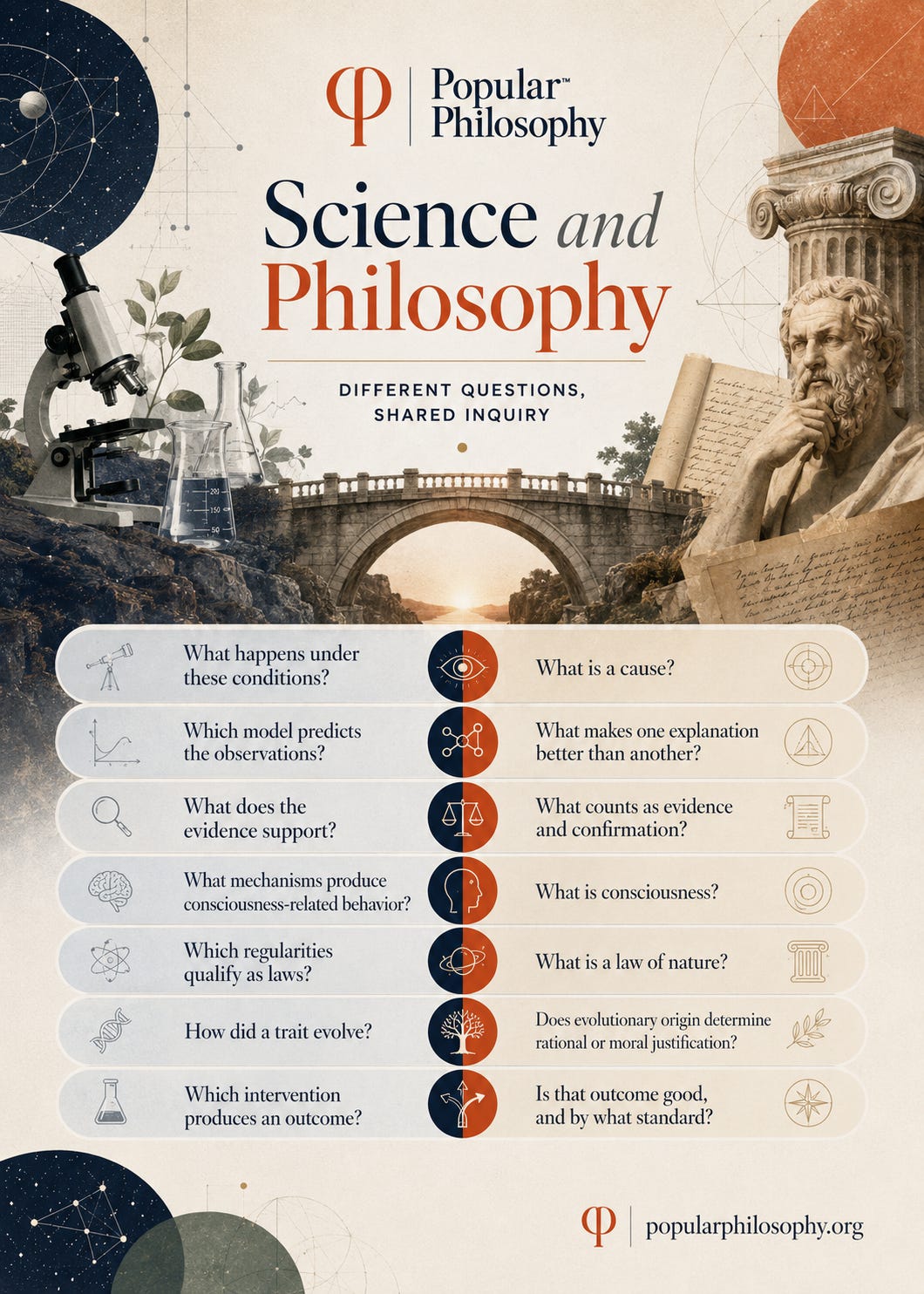
Science characteristically asks what happens under certain conditions. Philosophy can ask what a cause itself is and what it means for one event genuinely to explain another.
Science may ask which model best predicts the observations. Philosophy of science asks what makes one explanation better than another and whether predictive success is enough for a theory to count as explanatory.
Scientists ask what the evidence supports. Philosophers can examine what counts as evidence in the first place, what confirmation requires, and when evidence is strong enough to justify belief.
Neuroscience can investigate the mechanisms that produce behavior associated with consciousness. Philosophy of mind asks what consciousness is and how conscious experience relates to physical processes.
Science can identify regularities that appear lawlike. Philosophy asks what a law of nature is and whether laws describe patterns, govern events, or require some other interpretation.
Evolutionary biology can explain how a trait developed. Philosophy can then ask whether the evolutionary origin of a belief or behavior determines its rational or moral justification.
An empirical discipline may determine which intervention produces a particular outcome. Practical philosophy can still ask whether that outcome is good and by what standard it should be judged.
Bacon is crucial here because he changes the method of natural investigation. Kant asks how scientific knowledge itself is possible. Collingwood argues that philosophy reflects on categories that cannot simply be justified by pointing to empirical instances. Maritain distinguishes the specialized sciences from philosophy through their explanatory standpoint. Russell describes philosophy as critically examining principles that ordinary life and science often employ without making them their main subject.
Wittgenstein adds another warning. Some philosophical questions resemble scientific questions grammatically but are not requests for another empirical discovery. If confusion concerns the concept of mind, meaning, knowledge, or rule-following, gathering more measurements may leave the original confusion untouched.
The best conclusion is therefore neither “science replaced philosophy” nor “philosophy outranks science and can ignore evidence.”
Science is indispensable for questions that depend upon empirical facts. Philosophy examines questions of meaning, inference, explanation, normativity, metaphysical interpretation, and first principles that empirical measurement alone cannot settle.
Each can expose errors in the other when either exceeds its competence.
Philosophy and religion or theology
Philosophy and theology overlap because both can ask about God, creation, human nature, morality, providence, immortality, and the ultimate good.
Their characteristic starting points differ.
Philosophical argument, in the traditional sense relevant here, appeals to premises accessible to natural reason. Theology can additionally reason from premises accepted because they are held to have been revealed.
Philosophical theology before Christianity
Aristotle’s use of “theology” should not be confused with later Christian theology.
For Aristotle, the highest theoretical science investigates immovable and separable substance. Because this brings first philosophy to divine reality, he can call the discipline theological. However, his inquiry remains philosophical in method. It does not begin from Scripture or ecclesiastical revelation.
Truths of reason and truths of revelation
Thomas Aquinas makes the distinction between philosophy and theology explicit.
At the beginning of Summa Contra Gentiles, he distinguishes truths about God that natural reason can reach from mysteries that exceed the unaided capacity of human reason. God’s existence and unity belong to the first class in his account. The Trinity belongs to the second.
This distinction explains how philosophy and theology can investigate some of the same subjects without becoming the same discipline. A philosopher and a theologian might both ask whether God exists, what attributes God would have, or how God relates to the world.
What differs is the basis on which an argument is allowed to proceed. Natural theology is philosophical when it argues from premises that are meant to be available to human reason independently of revelation. A philosophical argument for God’s existence, for example, cannot simply assume that a revealed text is true and use that revelation as its decisive premise.
Sacred theology can also use reason, but it begins from a wider set of premises because revelation can function as an authoritative starting point within the theological inquiry. This allows theology to address claims that Aquinas thinks reason alone could not discover or demonstrate, such as the Trinity.
Philosophy and theology can therefore overlap in subject matter while remaining distinct in method and sources of authority. The important difference is not simply what they discuss, but what kinds of reasons are permitted to establish their conclusions.
The limits of speculative theology
Kant sharply restricts what theoretical reason can establish about God, the immortal soul, and other supersensible objects.
His critique does not treat religious questions as meaningless. Instead, he reorganizes them around the limits of speculative knowledge and the role of practical reason. That is why “What may I hope?” stands beside “What can I know?” and “What ought I to do?” in his map of reason’s interests.
So philosophy and theology can share objects while differing in epistemic authority, premises, and method.
Philosophy and rhetoric
Philosophy seeks truth through reasons. Rhetoric concerns persuasive communication.
The distinction is real, but the two need not be enemies.
Persuasion can outrun knowledge
Plato’s Gorgias stages the danger sharply.
Gorgias describes rhetoric as an art of persuasion. Socrates forces a distinction between persuasion that produces knowledge and persuasion that produces belief without knowledge. A rhetorician can sometimes appear more convincing to an uninformed audience than the person who actually understands the subject.
This gives philosophy a permanent reason to distrust mere persuasiveness.
A confident voice, emotional story, memorable slogan, prestigious credential, social consensus, or devastating debating performance does not itself establish a conclusion.
Rhetoric can serve reasonable judgment
Aristotle gives rhetoric a more constructive place.
His Rhetoric opens by calling rhetoric the “counterpart of Dialectic.” Both deal with matters accessible to ordinary reason and not confined to a specialized science. Rhetoric can therefore be treated systematically rather than dismissed as manipulation.
The philosopher still asks whether the premises are true and the inference succeeds. The rhetorician asks how a sound case can be made intelligible and persuasive to an actual audience.
Truth badly communicated can lose to error well communicated. That problem is examined further in Popular Philosophy’s essay on why Aristotle thought rhetoric matters.
Does philosophy produce knowledge?
Yes, although what kinds of philosophical knowledge are possible and how certain they can be are themselves philosophical questions.
A blanket answer that philosophy produces no knowledge is difficult to defend. The claim “philosophy produces no knowledge” is itself a sweeping epistemological judgment about the capacities of philosophical reasoning. It needs an argument.
There are several levels to consider.
Philosophy can establish logical and conceptual results
If an argument is formally invalid, philosophical analysis can show the failure.
If two propositions contradict one another, their incompatibility does not disappear because experimental data are absent.
If an alleged definition is circular, overinclusive, or inconsistent, that too can sometimes be established.
Philosophy can therefore produce negative knowledge with considerable strength: this conclusion does not follow, these positions cannot both be true in the specified sense, this definition fails to capture its intended class, or this objection attacks a different claim.
A defense of demonstrative knowledge
Aristotle has the highest ambitions concerning philosophical knowledge.
He thinks certain kinds of scientific and philosophical knowledge can grasp causes and necessities through demonstration. First principles cannot all be demonstrated, since demonstration would otherwise regress indefinitely, but this does not lead him to skepticism.
Knowledge of reason’s conditions and limits
Kant denies many traditional claims to speculative metaphysical knowledge while claiming strong results about the structures and limits of cognition.
A successful critique can therefore produce knowledge partly by identifying what reason cannot legitimately claim.
Knowledge of a limit is still knowledge.
Skepticism about final answers, but not about philosophy itself
Russell gives philosophy less metaphysical certainty than Aristotle.
He acknowledges that philosophy has not accumulated a settled body of results resembling mature sciences. He also says that philosophy aims at knowledge and that critical examination can preserve ordinary knowledge when it survives scrutiny while exposing beliefs that do not.
For Russell, uncertainty can itself have intellectual value because it loosens unexamined dogmatism and keeps open possibilities we had failed to consider.
A distinctive mode of knowledge
Collingwood resists treating philosophy as failed empirical science.
Philosophical concepts and judgments operate differently from the classifications of exact and empirical sciences. The philosopher can therefore investigate the presuppositions and categorical structure of forms of inquiry without competing with a laboratory over laboratory findings.
Philosophical history as accumulated experience
Gilson’s argument runs through the history of attempted reductions of philosophy to logic, theology, mathematics, physics, and sociology.
Whatever judgment one reaches about his Thomistic conclusions, the methodological point remains significant. Philosophy does possess a cumulative history. Old arguments can fail in recurring ways. Distinctions can be lost and rediscovered. An attempted solution can expose the structure of a problem even when the solution itself fails.
Philosophical progress therefore need not look exactly like technological progress.
Why philosophy is valuable
Asking what philosophy is “good for” can quietly assume that the value of every activity lies in producing something else.
The classical philosophers challenge that assumption.
Some knowledge is pursued for its own sake
Aristotle explicitly connects philosophy with freedom from immediate utility.
Human beings first pursue necessary arts. Once basic needs have been addressed, forms of knowledge sought simply for understanding become possible. Because wisdom is not subordinate to another practical product, he describes it as a “free” science. He concludes that other sciences may be more necessary, but none is better.
That argument deserves to be taken literally.
If every activity required justification by some further activity, an infinite regress of usefulness would follow. Eventually we need goods that are desired because they are good, not merely because they produce something else.
Knowledge can be one of those goods.
Philosophy concerns the condition of the person
For Socrates, philosophical examination is tied to the condition of the soul.
His concern in the Apology is that people pursue money, status, and reputation while neglecting wisdom, truth, and virtue. Philosophy can therefore have practical consequences without becoming a mere technique for acquiring external goods.
The question is not simply whether philosophy improves your salary. It is whether a person who cannot distinguish knowledge from confidence, persuasion from truth, good from pleasure, or justice from power is living intelligently.
Philosophy enlarges the field of thought
Russell defends philosophy precisely against the “practical” person who recognizes only material needs.
Even where philosophy cannot deliver final certainty, philosophical questions expose unnoticed possibilities, weaken the tyranny of inherited assumptions, and expand intellectual imagination.
This is not a consolation prize for a discipline that failed to become physics. It follows from the kind of objects philosophy considers.
Usefulness is too small a measure for philosophy
Josef Pieper’s In Defense of Philosophy directly confronts the objection that philosophy does not “serve a purpose.”
His answer returns to contemplation. Philosophy reflects upon reality as a whole in light of ultimate reasons. It therefore belongs among activities whose value cannot be exhausted by asking what product comes off the assembly line afterward.
Pieper’s deeper target is a culture in which everything must justify itself by immediate usefulness. On those terms, contemplation, art, truth pursued for itself, and even much of friendship and love become difficult to defend.
The criticism exposes a philosophical assumption hiding inside an apparently practical objection: why should usefulness be the ultimate standard of value?
Philosophy is not the same as having “a philosophy”
Ordinary English sometimes uses philosophy to mean a personal maxim or general attitude.
A business may have “a philosophy of customer service.” Someone may say that his “philosophy of life” is to avoid worrying about things he cannot control.
Such positions can contain philosophical ideas, but philosophy as an intellectual discipline demands more.
A claim becomes philosophically serious when its concepts can be clarified, its reasons stated, its assumptions exposed, its consequences followed, and objections answered.
“My philosophy is that everyone should do whatever makes them happy” is therefore the beginning of an argument, not the end of one.
What is happiness? Does one person’s happiness justify harming another? Can people be mistaken about what makes them flourish? Why should happiness override justice? Is immediate pleasure equivalent to a good life?
One apparently simple slogan can open an entire ethics course.
Philosophy is not merely opinion
The statement “everyone has their own philosophy” easily slides into the idea that philosophy is a field where everyone simply has opinions.
That misunderstands disagreement.
Two people can disagree about a mathematical proof, a murder trial, a medical diagnosis, or a historical event. Their disagreement does not prove that there is no correct answer. It proves only that at least one person has not yet persuaded the other.
Philosophical disagreements must therefore be assessed through reasons.
Some positions are internally contradictory. Some arguments equivocate between meanings. Some depend on false factual premises. Some ignore obvious counterexamples. Some objections succeed only against weak versions of the opposing position.
Philosophy becomes valuable precisely when it gives us a disciplined way to distinguish disagreement from equality of justification.
Philosophy is not skepticism for its own sake
Doubt can clear away false certainty. Permanent doubt can also become intellectually sterile.
Descartes doubts in order to find what cannot be doubted. Hume employs skepticism but rejects impractical total skepticism. Kant criticizes reason in order to establish its legitimate boundaries. Russell explicitly distinguishes philosophical criticism from an absolute skepticism that refuses to begin from any shared knowledge.
Socrates’ admission of ignorance leads him to inquiry, not resignation.
A healthy philosophical question is therefore rarely “How can I prove that absolutely nothing is knowable?”
It is more often: “Exactly what do I know here, how do I know it, and where does my justification end?”
What philosophy can teach a beginner to do
A first encounter with philosophy should change intellectual habits before it fills the memory with doctrines.
You should become harder to impress with confident language. You should notice when an argument changes definitions halfway through. You should ask what kind of claim is being made. You should distinguish evidence for a proposition from the proposition’s popularity. You should recognize the difference between showing that an argument fails and proving that its conclusion is false.
You should also become more comfortable saying “I do not yet know.”
That sentence is productive when followed by the right question.
The Socratic, Aristotelian, Cartesian, Baconian, Humean, Kantian, and Wittgensteinian traditions disagree profoundly about philosophy. Yet they converge on one intellectual demand: do not let the apparent familiarity of a thing substitute for understanding it.
Where should a beginner start?
The best first texts demonstrate philosophy rather than merely describe it.
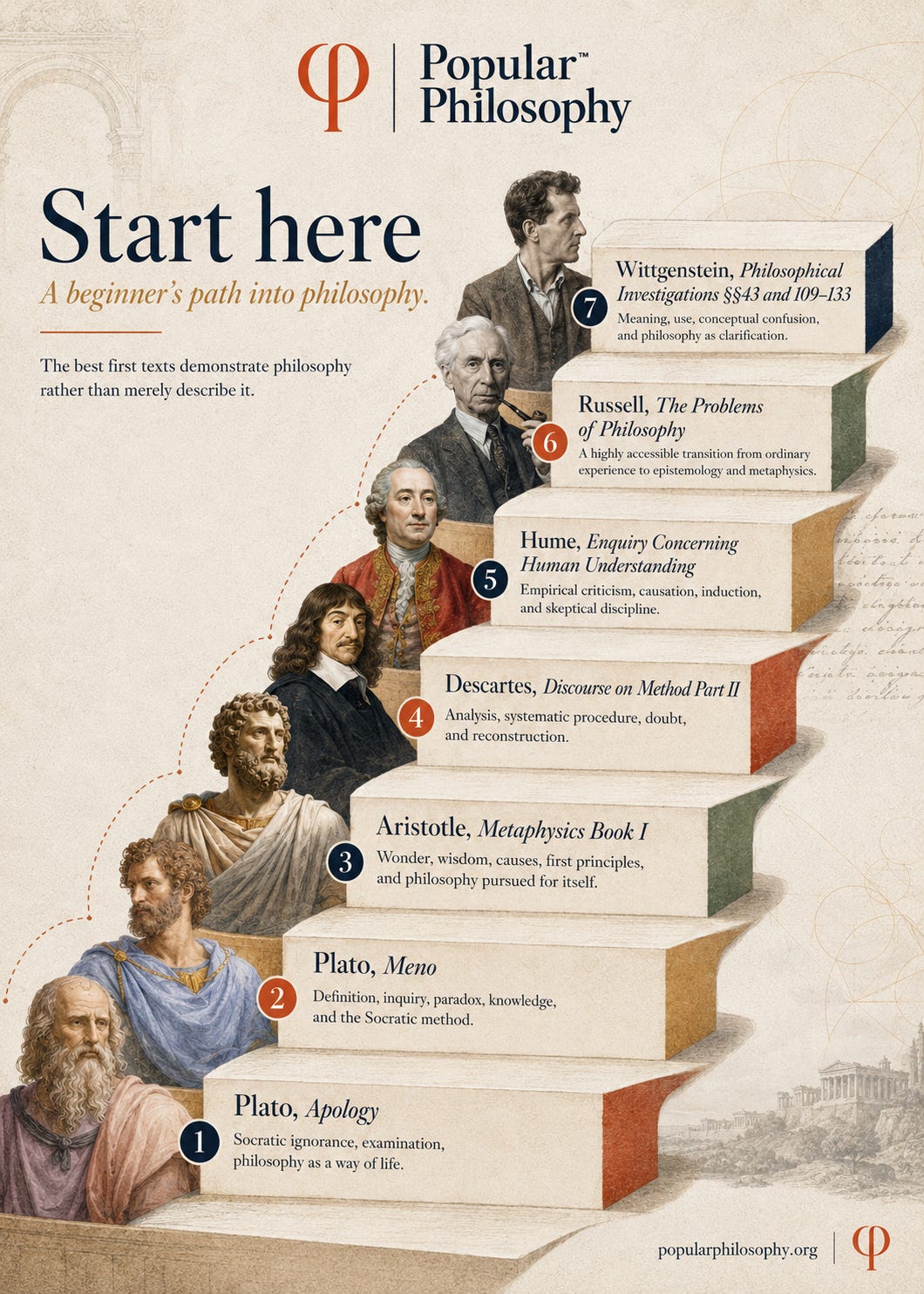
1. Plato, Apology
Plato’s Apology is a strong starting point for learning about Socratic ignorance, philosophical examination, and the idea of philosophy as a way of life.
2. Plato, Meno
Plato’s Meno develops those themes through questions about definition, inquiry, paradox, knowledge, and the Socratic method.
3. Aristotle, Metaphysics
Aristotle’s Metaphysics Book I introduces wonder, wisdom, causes, first principles, and the idea that some forms of understanding can be pursued for their own sake.
4. Descartes, Discourse on Method
Descartes’ Discourse on Method Part II offers a concise introduction to analysis, systematic procedure, doubt, and the attempt to reconstruct knowledge from secure foundations.
5. Hume, Enquiry Concerning Human Understanding
Hume’s Enquiry Concerning Human Understanding is especially valuable for learning how empirical criticism works in questions about causation, induction, and skepticism.
6. Russell, The Problems of Philosophy
Russell’s The Problems of Philosophy provides one of the most accessible transitions from ordinary experience into epistemology and metaphysics.
7. Wittgenstein, Philosophical Investigations
For a very different conception of philosophy, Wittgenstein’s Philosophical Investigations, especially §§43 and 109–133, introduces the importance of meaning, use, conceptual confusion, and philosophy as clarification.
A beginner does not need to agree with any of these philosophers. The point is to watch great thinkers turn apparently simple questions into explicit problems, arguments, distinctions, and objections.
These readings also show why beginning with philosophy is different from memorizing a glossary. Each text makes a problem unfold through reasoning. The reader sees a confident assumption become a question, a question become a distinction, and a distinction become an argument that can be tested. That movement is more important at first than mastering a large inventory of doctrines.
Once the habit of philosophical thinking is familiar, the branches of philosophy become easier to navigate because their specialized questions can be recognized as variations on the same demands for definition, justification, coherence, and explanation.
Philosophy begins when the obvious becomes a question
Philosophy is difficult to define because it can turn almost any subject into a deeper inquiry. That does not make it shapeless.
Its recurring object is intelligibility at the level where ordinary assumptions themselves become questionable.
What is real? What can be known? What follows from what?
What is good? What makes authority legitimate?
What is a mind? What does language mean?
What can science explain? What can reason know about God?
What is law?
What kind of life is worth living?
The oldest philosophical impulse survives inside all of these questions. Socrates recognizes that supposed knowledge has outrun its justification. Aristotle wonders why things are as they are. The philosopher then begins the slow work of definition, distinction, argument, criticism, and judgment.
Philosophy is therefore neither the possession of wisdom nor the celebration of endless uncertainty. It is the rational pursuit of wisdom by people who know there is still something to understand.
References
Aquinas, Thomas. Summa Contra Gentiles. Book I, chap. 3, “The Two Ways of Knowing the Truth about God.” The article relies particularly on the distinction between truths attainable by natural reason and truths exceeding unaided human reason.
Aquinas, Thomas. Summa Theologiae. I–II, q. 94, especially art. 2, “Whether the Natural Law Contains Several Precepts, or Only One?” Relevant to practical reason, natural law, and the first precept that good is to be done and pursued and evil avoided.
Aristotle. Metaphysics. Translated by W. D. Ross. The Internet Classics Archive. Relevant passages include I.1–2, 981a–983a, on wisdom, causes, wonder, and knowledge pursued for its own sake, and IV.1, 1003a21ff., on the science of being qua being. See also VI.1 on first philosophy and theological science.
Aristotle. Posterior Analytics. Translated by G. R. G. Mure. The Internet Classics Archive. Especially I.1–2, including 71b–72a, on demonstration, prior principles, and explanatory knowledge.
Aristotle. Rhetoric. Translated by W. Rhys Roberts. The Internet Classics Archive. Especially I.1, 1354a1ff., on rhetoric as the counterpart of dialectic.
Aristotle. Topics. Translated by W. A. Pickard-Cambridge. The Internet Classics Archive. Especially I.1–2, on dialectical reasoning from generally accepted opinions (endoxa) and the uses of dialectic.
Aristotle. “The Role of Metaphysics in the Knowledge of Reality.” INTERS. Extracts from Metaphysics II.1, IV.1, and VI.1. Translated by W. D. Ross. Used in the article for Aristotle’s account of first philosophy, being qua being, and the place of theology among the theoretical sciences.
Bacon, Francis. Novum Organum: Or, True Suggestions for the Interpretation of Nature. Edited by Joseph Devey. Project Gutenberg, eBook no. 45988. Especially bk. I, aphs. 19–68, on induction and the Idols of the Tribe, Den, Market, and Theatre.
Collingwood, R. G. An Essay on Philosophical Method. Rev. ed. Edited by James Connelly and Giuseppina D’Oro. Oxford: Clarendon Press, 2005. Originally published 1933. Especially p. 35 on the distinctive behavior of philosophical concepts, and pp. 127–29 on categorical philosophical thinking and its relation to empirical inquiry.
Descartes, René. Discourse on the Method of Rightly Conducting One’s Reason and of Seeking Truth in the Sciences. Translated by John Veitch. Project Gutenberg, eBook no. 59. Especially pt. II, containing Descartes’s four rules of method.
Geudens, Ben. “Being Right Isn’t Enough: Why Rhetoric Matters.” Popular Philosophy, January 3, 2013. Examines Aristotle’s account of rhetoric as a practical complement to dialectic and the problem of communicating truth effectively.
Geudens, Ben. “The Quiet Theology of Anti-Metaphysics.” Popular Philosophy, March 6, 2026. Used as a related exploration of how metaphysical assumptions can persist within ostensibly anti-metaphysical systems.
Geudens, Ben. “What Is Moral Realism? The Case for Objective Moral Truth.” Popular Philosophy, March 6, 2014. Provides a fuller treatment of moral realism, objective moral truth, and the historical arguments surrounding moral objectivity.
Gilson, Étienne. The Unity of Philosophical Experience. London: Sheed and Ward, 1938. Especially the foreword, pp. vii–viii, and chap. 12, pp. 305–24, on the historical unity of philosophical experience and repeated attempts to reduce philosophy to other modes of inquiry.
Hume, David. An Enquiry Concerning Human Understanding. Edited by L. A. Selby-Bigge. Project Gutenberg, eBook no. 9662. Especially secs. IV–V on causal inference, induction, and custom, and sec. XII on mitigated skepticism.
Kant, Immanuel. The Critique of Pure Reason. Translated by J. M. D. Meiklejohn. Project Gutenberg, eBook no. 4280. Used for Kant’s critical inquiry into the possibility, legitimate scope, and limits of human knowledge.
Kant, Immanuel. Logic. Edited by Gottlob Benjamin Jäsche. 1800. Especially Akademie-Ausgabe 9:25, where Kant gives the four questions “What can I know?,” “What ought I to do?,” “What may I hope?,” and “What is the human being?”
Lewin, Michael. “Kant’s Metaphilosophy.” Open Philosophy 4, no. 1 (2021): 292–310. Used as scholarly corroboration for Kant’s conception of philosophy and the Jäsche Logic formulation.
Liddell, Henry George, Robert Scott, and Henry Stuart Jones. A Greek-English Lexicon. s.v. “φιλοσοφία.” Scaife ATLAS. Used for the Greek senses of philosophia, including love or pursuit of knowledge and wisdom, speculation, and study.
Locke, John. An Essay Concerning Humane Understanding. Based on the 2nd ed. Project Gutenberg. Vol. 1, Books I–II, eBook no. 10615 and vol. 2, Books III–IV, eBook no. 10616. Especially Introduction §§2, 6–7 on the scope and powers of the understanding, Book III on words and language, and Book IV on knowledge, certainty, probability, and assent.
Maritain, Jacques. An Introduction to Philosophy. Translated by E. I. Watkin. London: Sheed and Ward, 1932. Especially pt. I, chaps. V–VII, on the definition of philosophy, its relation to the special sciences, and its relation to theology, and pt. II, chap. I, on the principal divisions of philosophy.
O’Shea, James R. “On Kant’s Janus-Faced Transcendental and Empirical Conception of the Human Being.” International Journal of Philosophical Studies 31, no. 2 (2023): 242–52. Used in connection with Kant’s four fundamental philosophical questions and their relation to philosophical anthropology.
Pieper, Josef. In Defense of Philosophy: Classical Wisdom Stands Up to Modern Challenges. Translated by Lothar Krauth. San Francisco: Ignatius Press, 1992. Especially chaps. IV–V, on philosophy as free theoretical inquiry, contemplation, truth pursued for itself, and the inadequacy of immediate usefulness as the measure of philosophical value.
Plato. Apology. Translated by Benjamin Jowett. The Internet Classics Archive. Especially 21d on Socratic ignorance, 29d–30b on the care of wisdom and the soul, and 38a on the examined life.
Plato. Gorgias. Translated by Benjamin Jowett. The Internet Classics Archive. Especially 454e–455a on persuasion, belief, and knowledge, used in the article’s distinction between philosophical inquiry and rhetoric.
Plato. Meno. Translated by Benjamin Jowett. The Internet Classics Archive. Especially 70a–80d on the definition of virtue, inquiry, and perplexity, and 97a–98a on knowledge and true opinion.
Plato. Symposium. Translated by Benjamin Jowett. The Internet Classics Archive. Especially 203e–204b, where the lover of wisdom occupies the intermediate position between wisdom and ignorance.
Popular Philosophy. “Start Here: Philosophy Articles, Guides and Reading Paths.” Popular Philosophy. Last updated July 12, 2026. Serves as the introductory navigation guide connecting readers with foundational philosophy articles, concepts, thinkers, and reading paths.
Russell, Bertrand. The Problems of Philosophy. Project Gutenberg, eBook no. 5827. Especially chap. 1 on appearance and reality, chap. 6 on induction, chap. 14 on the limits of philosophical knowledge, and chap. 15 on the value of philosophy.
Villaggi, Filippo, Désirée Weber, and Michele Lavazza. “Introduction to Wittgenstein’s Philosophical Investigations.” The Ludwig Wittgenstein Project, August 24, 2025. Used as supplementary interpretation of Wittgenstein’s conception of meaning, ordinary linguistic practice, and philosophical clarification.
Wittgenstein, Ludwig. Philosophische Untersuchungen [Philosophical Investigations]. The Ludwig Wittgenstein Project. Especially §§43, 109, 116, 133, and 309, on meaning as use, philosophical problems as conceptual or grammatical confusion, ordinary use, the plurality of philosophical methods, and the fly-bottle image.
Wittgenstein, Ludwig. “Ts-227b.” Wittgenstein’s Writings. Especially the material corresponding to Philosophical Investigations §309.
Explore more Popular Philosophy:
Start Philosophy | Concepts | Thinkers | Traditions | Topics | Today in Philosophy | Podcast
Popular Philosophy publishes definitive guides and essays centered around realism, moral philosophy, Stoicism, classical philosophy, medieval philosophy, and deeper explorations of the true, the good and the beautiful. Expect carefully researched articles that dissect current event through timeless ideas, for readers who want clear reasoning, primary sources, intellectual honesty, and serious philosophy free from ideological trends and academic fashion.
Subscribe now to support our growing, independent philosophical knowledge base devoted to the timeless questions that shape human life and civilization.